
You Can Do This
Jeff Greenberg on the magic and depth of Celeste
Jeff Greenberg
3/23/20267 min read
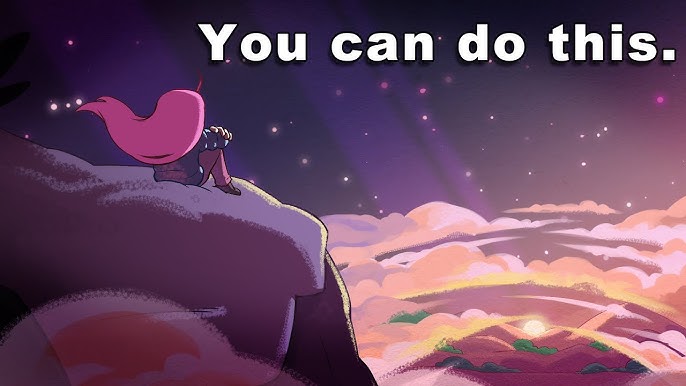
There is a sentence that appears on screen near the very beginning of Celeste — before the first level, before the music swells, before you have died even once. Madeline, the game's protagonist, sits alone on a mountainside in the dark, and the words appear like a quiet instruction, or a dare:
You can do this.
It is four words. It is also, depending on where you are in your own life when you encounter it, one of the more affecting things a video game (or other art piece) has ever said. The sentence is not directed at the mountain. It is directed inward. That distinction is what Celeste is built on, chapter by chapter, failure by failure, for the entirety of its journey.
Released in January 2018 by Maddy Thorson and Noel Berry, Celeste is a precision platformer - a game in which you guide a character through obstacle courses of pixel-perfect difficulty, dying constantly, learning, trying again. That is the mechanical description. The emotional one is harder to write. After all, this is a multi-faceted piece of art.
Celeste is a game about a young woman who decides to climb a mountain as a way of confronting her anxiety and depression, and who discovers that the relationship she has with herself is the most difficult terrain she will navigate. It is among the most honest portraits of mental illness that any medium has produced. And it arrived, in large part, because its creator was working through something she didn't yet have words for.
The mountain as decision
Celeste Mountain is described early on as a place that amplifies whatever is already inside you. There are warning signs. Madeline goes anyway.
Her stubbornness is part of the characterization, established quickly and precisely. In her first conversation with an old woman at the base of the mountain, a mild dig about her chances tips Madeline from polite to prickly in seconds. The game is already showing you how anxiety and low self-worth can make ordinary social friction feel like an attack - how that internal weather makes you sensitive to things that others let slide.
Madeline's decision to climb is also framed as something more than ambition. She is not training for a race or chasing a view. She needs to do this, even if she cannot fully explain why. That motivation - the compulsive reaching toward a hard thing because something inside insists on it - is recognizable to anyone who has ever tried to move through their own difficulties by progressing toward something demanding. The mountain is not chosen despite being hard. It is chosen because of it.
The game understands, from its very first chapter, that people dealing with anxiety and depression do not always retreat from a challenge. Sometimes they run straight at it, for reasons that are complicated and not always easy to defend or comprehend.
The shadow in the mirror
Early in the game, Madeline comes face to face with a version of herself. The encounter is the game's central relationship, and everything that follows flows from it.
What she meets is not a stranger. It is recognizably her - her face, her colour palette inverted, her manner distorted by something darker. Known by players as Badeline, this figure is the personification of Madeline's anxiety and self-doubt, externalized by the mountain and given a voice. That voice is sharp and certain. It says the things Madeline has already been saying to herself in quieter moments: that she is not capable of this, that she is fooling herself, that the gap between who she wants to be and who she is cannot be climbed.
Badeline is not a villain in any conventional sense. She is not wrong about everything. What makes her so unsettling is precisely that - the way the internalized critic tends to be anchored in something real, even when it distorts and exaggerates. She is the part of Madeline that has been fed by every failure and every harsh self-assessment, and she has been living inside long enough to become fluent in the architecture of Madeline's specific fears. How Madeline chooses to respond to this reflection - and how that response evolves over the course of the mountain - is the story Celeste is telling. The game does not offer a clean answer early. It offers instead what tends to happen when you first come face to face with the worst version of yourself.
The panic attack in the gondola
There is a sequence in the fifth chapter that has been cited more than almost anything else in the game by people who live with anxiety — and by the therapists who work with them.
Madeline and Theo, a fellow climber she has befriended on the mountain, find themselves trapped together in a malfunctioning gondola suspended over a long drop. The gondola sways. The music shifts. On screen, Madeline's breathing becomes labored.
Theo talks her through a grounding exercise. He asks her to picture a feather — to breathe in as it rises, breathe out as it falls. The feather appears on screen, and the game gives you control of it. Pressing a button lifts it. Releasing lets it drift down. You breathe with Madeline. The music slows. The gondola steadies.
It is a two-minute sequence that has been described by people in crisis as one of the more useful representations of a coping technique they have encountered anywhere — not because it prescribes a solution, but because it makes you feel, in your hands and in your chest, what regulated breathing does. The feather is not a metaphor. It is an instruction, delivered gently, to a player who might need it.
The music underneath everything
Lena Raine composed Celeste's score with a specific mandate: the music should track Madeline's internal state almost one-to-one. The result is a soundtrack that functions as emotional annotation throughout.
The chapter two theme, In the Mirror, contains a detail that most players never consciously notice. Raine's own voice is threaded through the mix, recorded and reversed - whispering words that sit just below the threshold of intelligibility. If you reverse the track, they resolve into something specific: a lament about inadequacy, followed by quiet sobbing. That sound is present in every playthrough, almost but not quite audible. It is a perfect technical metaphor for the experience of anxiety itself - the constant low-frequency presence of something you cannot hear clearly, but that is always there, shaping everything.
Thorson’s hidden creation
Celeste began as a prototype that Thorson and Berry built in a weekend in 2015. The version that became the full game grew from a decision Thorson made during development, when her own depression and anxiety reached, in her words, “a breaking point that could no longer be managed or ignored.” Writing those experiences into the game was difficult because they were still happening.
When Celeste shipped in 2018, it was understood as a game about anxiety and depression. The mountain was the metaphor. The message was about persisting and learning to live alongside the worst versions of your own thoughts. All of that was true, and it landed.
What Thorson did not yet know was that the game was also a vehicle for self-discovery. In November 2020, she published an essay affirming her transition and stating that Madeline was canonically a transgender woman. She wrote: “During Celeste's development, I did not know that Madeline or myself were trans. During the Farewell DLC's development, I began to form a hunch. Post-development, I now know that we both are”.
The game had been made as an act of processing something she could not name, through a character she didn't yet fully understand. The meaning only arrived after the work was done.
The game emphasizes the long, difficult negotiation with the part of yourself you most want to escape. The shadow version of yourself insisting you are not what you think you are. The mountain that surfaces what you have been carrying. None of it was coded intentionally as a story about gender identity. All of it maps onto that story with an accuracy that feels less like coincidence than like the unconscious doing what it does - working things out in the dark, leaving evidence everywhere, waiting for you to catch up.
Why it still lands
Celeste is available on Nintendo Switch, and this is where I keep returning to it - handheld, in fragments of quiet. There is something right about playing it privately. It asks for some privacy.
You will die in Celeste hundreds of times, in some sections, thousands. The game tracks your death count and displays it without comment. It is not an accusation. It is a record of persistence - evidence that you kept going, that each attempt was also a small act of recommitment. The game does not shame you for struggling. Assist modes are available - reduced speed, extra dashes, invincibility — and they are offered without judgment in the game's own menus, framed as tools rather than concessions. The message about perseverance is not a message about suffering through things unaided. It is a message about continuing. How you continue is yours to decide.
The games that stay with you are the ones that use the art form to say something that cannot be said as well in another way. Celeste could not have been a film, or a novel, or a song. The dying and the trying again, the feather rising as you breathe in - those are things that happen to you, not things you observe happening to someone else. You are not watching Madeline climb. You are climbing with her, failing with her, getting back up with her. That is the power of this medium when it is used deliberately, and Celeste is a masterclass.
You can do this. Four words, before the first level, in the dark.
It turns out they were not only for Madeline.


Jeff Greenberg is a Toronto writer, proud early voice at accordingto.ca. He writes about Jewish identity, parenthood, career reinvention, and pop culture — and when he's not doing that, he's deep in an RPG on Switch, hunting rare rock posters, or at an indie or jam show. His best hours are spent with his beautiful kids and wife.
Get in on the conversation:
At accordingto.ca, We Believe in Rebuilding the Missing Middle.
If you believe in what we’re doing:
Subscribe. It’s free, and it tells us you’re with us.
Share. If something moves you, pass it on. Help us grow.
Contribute. Know someone who should be writing for us? Tell them. Or tell us.
We’re building something here. And we can’t do it alone.
accordingto
Our mission is to refresh the conversation, and democratize public discourse. We platform smart and spectacular people who are ready to challenge assumptions, explore nuance, and speak with clarity.
Contact
Subscribe
info@accordingto.ca
Discord: https://discord.gg/GUZeHrmZ
© 2026. All rights reserved.