The Real State of Canadian Childhood: A Promise We Keep Breaking
Lauren Reid digs into the data to answer the question: "Why isn't Canada fulfilling the promise we made to our kids?"
Lauren Reid
3/13/20266 min read
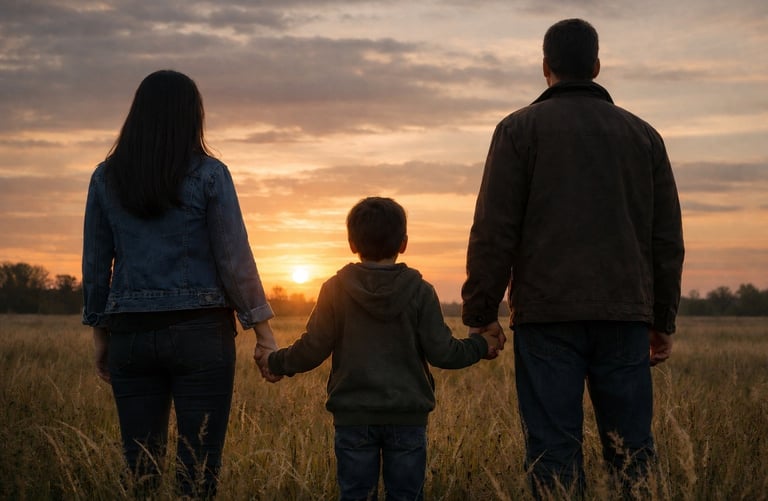
Nelson Mandela once said that "there can be no keener revelation of a society's soul than the way in which it treats its children." It is a line that has never felt more relevant than it does right now in our country.
There is a version of Canadian childhood that lives comfortably in the national imagination. Think backyards and road hockey, schools with world class education, food on the table, neighbours who know your name, and the broad belief that this is one of the best places in the world to raise a family. It is a comforting thought, but for many Canadians, the faith behind it is fading.
I am one of them, in many ways. I was born here, and so were my two sons. I am raising them in the same country I grew up believing was one of the good ones, the kind of place that takes care of its people, especially its children. As a parent, I know that part of raising a family means staying adaptable to a country and a world that are changing faster than any of us anticipated. We should be able to give our children lives that are meaningful, safe, full of opportunity, and equal to the standard Canada wrote into its own Charter of Rights and Freedoms. But our country's own data has been telling a different story, and it has become impossible to deny and irresponsible to ignore.
What a Canadian Childhood Looks Like Right Now
Consider something as fundamental as food. According to Food Insecurity Policy Research (PROOF) and Statistics Canada's Income Survey, one in three Canadian children, 2.5 million in total, lived in a household without reliable access to food due to financial constraints in 2024, a record high. That figure doesn't include children on First Nations reserves or in the territories, where the data that does exist tells a far grimmer story. Among Indigenous Peoples living off-reserve, food insecurity sits at nearly 40%, according to PROOF. In Nunavut, Statistics Canada data shows 58% of the population lives in a food-insecure household. On-reserve communities are excluded from national surveys entirely, meaning the full picture is likely worse than any number we currently have.
We are not talking about a country without resources. We are talking about one of the wealthiest nations in the G7, and those numbers should stop us in our tracks.
Behind the food numbers lies the reality of what it means to grow up poor in Canada. In 2025, Campaign 2000, a national non-partisan coalition that has tracked child poverty since 1989, reported that nearly 1.4 million children were living in poverty in 2023, a rate of 18.3%. Child poverty rose for the third consecutive year, with nearly 30,000 additional children falling into poverty in a single year. UNICEF's most recent Report Card places Canada 19th out of 39 high-income countries on child poverty rates. It can be easy to read past numbers like these, but behind every percentage point are children who deserve better.
Education was supposed to be the great equalizer. It is struggling to live up to that promise in Canada right now. The institutions meant to give every child an equal start are quietly being hollowed out by chronic underfunding. In Ontario, Canada's largest province and home to the most students, school boards are receiving $260 less per student than they did in 2018, representing a funding shortfall of over $560 million for the 2025 to 2026 school year alone, according to the Canadian Centre for Policy Alternatives. Since 2018, the cumulative shortfall has reached over $6 billion. Ontario is not alone. Across the country, five provinces including Alberta, Saskatchewan, Manitoba, and Newfoundland and Labrador have seen inflation-adjusted per-student spending decline over the past decade, according to the Fraser Institute's 2025 national education spending report.
Then there is the matter of how our children are coping inside all of this. The Canadian Institute for Health Information reported in 2024 that 36% of children and youth aged two to 17 with a diagnosed mental health condition had needs that were partially or completely unmet. That is more than one in three children who already have a diagnosis, already have a name for what they're experiencing, and still cannot reliably access care. It is hard not to feel the weight of that as a parent, and harder still to accept that it keeps being true year after year in a country that insists it knows better.
What We Say and What We Do
Canada has never been short on intentions. In 1989, Parliament passed a unanimous resolution to end child poverty by the year 2000. We signed the United Nations Convention on the Rights of the Child in 1991. We created the Canada Child Benefit, which prevented more than 580,000 children from falling into poverty in 2023 alone, and built a national childcare framework. It was real, measurable progress.
And yet Campaign 2000 reports that the Benefit has since lost much of its power, its value eroded by inflation and structural limitations that leave out many of the children who need it most. Indigenous children continue to experience poverty at three to four times the rate of non-Indigenous children, a distance that has remained stubbornly wide across governments of every stripe. Children and families have long been a fixture of Canadian political platforms, cited by every party as central to their vision for Canada. The promise gets made sincerely, and then quietly broken in the years that follow. Together, these are not isolated failures but the real state of Canadian childhood, and what looking away has cost us.
What Other Countries Have Figured Out
Canada is not the first wealthy country to sit with this kind of contradiction, and there are places that have found their way to different outcomes. UNICEF's 2025 Innocenti Report Card found that the Netherlands, Denmark, and France consistently rank at the top across child mental health, physical health, and skills, positions they have held across multiple report cards. What they share is not a single transformative policy. It is a cultural baseline, one where child wellbeing is treated as a collective responsibility rather than something each family navigates on its own, and that value gets embedded into everything from school design to parental leave to how cities are planned.
In the Netherlands, child poverty sits at 2.8%, among the lowest of any wealthy nation in the world, and researchers have linked a culture of inclusion and acceptance, one where children feel free to grow into who they are, to stronger peer relationships and higher reported levels of happiness. In Denmark, broad political consensus around early childhood investment has held across all major parties for decades, making it not a left or right commitment but simply the expected standard. These countries didn't arrive here by accident or on the strength of one inspired government. They made a collective decision, over time, that the distance between their values and their outcomes was worth taking seriously.
What We Can Choose
Canada already has the research, the institutions, and the wealth to move differently on this. What is needed is not a new idea. It is the decision to treat child wellbeing as something that belongs to everyone, not just to the families living it every day. The late justice Murray Sinclair, who led the landmark Truth and Reconciliation Commission, often reminded us that the most important question for any child is, "Who am I?" He believed our systems fail when they stop helping children answer that.
Concern for the next generation has never been a partisan issue, and it shouldn't become one now. My sons are growing up Canadian, and I want that identity to hold the same inherent value it did for the generations before them. We all want the same foundational things for our kids: love, community, opportunity, and the chance to thrive. Canada promised its children a country that takes care of them. The data is in. The urgency is real.
What we do next is a choice.
Lauren Reid is a freelance writer with a background in broadcast journalism and communications. She has written on topics ranging from chemistry to parenting to business, always searching for the human story behind the headlines. A mom of two young boys, she spends her weekends like many Canadian parents do, at the hockey rink watching their young aspiring NHL stars play what generations of Canadians have called the greatest game in the world.
Get in on the conversation:
SOURCES:
PROOF Food Insecurity Policy Research, University of Toronto. New Data on Household Food Insecurity in 2024. May 2025. proof.utoronto.ca
Statistics Canada. Canadian Income Survey. Annual. statcan.gc.ca
Campaign 2000 — Ending Child Poverty: The Time Is Now — 2025 Report Card on Child and Family Poverty in Canada (February 2026): campaign2000.ca
UNICEF Canada/UNICEF Innocenti. Child Poverty in Canada: Let's Finish This — Report Card 18. December 2023. unicef.ca
UNICEF Innocenti. Report Card 19: Child Wellbeing in an Unpredictable World. May 2025. unicef-irc.org
Canadian Institute for Health Information. Many Canadians with Mental Health Disorders Are Not Having Their Needs Met. 2024. cihi.ca
Canadian Institute for Health Information. Child and Youth Mental Health. May 2025. cihi.ca
At accordingto.ca, We Believe in Rebuilding the Missing Middle.
If you believe in what we’re doing:
Subscribe. It’s free, and it tells us you’re with us.
Share. If something moves you, pass it on. Help us grow.
Contribute. Know someone who should be writing for us? Tell them. Or tell us.
We’re building something here. And we can’t do it alone.
accordingto
Our mission is to refresh the conversation, and democratize public discourse. We platform smart and spectacular people who are ready to challenge assumptions, explore nuance, and speak with clarity.
Contact
Subscribe
info@accordingto.ca
Discord: https://discord.gg/GUZeHrmZ
© 2026. All rights reserved.