
The Middle We Refuse To See
Finding Nuance and the Middle Ground When Examining the Israeli-Palestinian Conflict
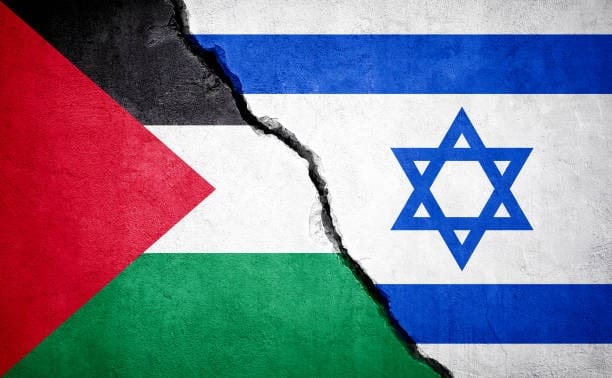

One of the most misleading stories told about the Israeli–Palestinian conflict is that it is defined by two fixed and irreconcilable camps. From the outside, it appears as a clean moral binary: us and them, right and wrong, irredeemable extremists on both sides. That framing is emotionally satisfying. It is also politically lazy.
Spend time inside the conflict and among the people living and working in the region, and a different picture emerges. Not one of harmony or imminent peace, but of a large, politically meaningful middle that is routinely ignored because it resists clarity. These are people who are undecided, ambivalent, conflicted, or simply exhausted. They do not map neatly onto ideological categories, and they rarely get airtime. But they matter far more than we admit.
There is a key principle in organizational psychology, developed by Chris Argyris, called the ladder of inference. It describes how people move from raw information to beliefs and actions. We do not absorb facts neutrally; we filter them through inference and assumption, shaped by experience, memory, fear, and identity. Over time, we become so confident in our conclusions that we forget they were ever interpretations at all. The ladder helps explain how two groups can witness the same events and arrive at entirely incompatible moral worlds.
In protracted conflicts, this process becomes collective. Entire societies climb the ladder together. And once a conflict is framed as a battle between two immutable camps, something important happens: we stop looking for people who are not fully committed to either story. When the middle is ignored long enough, it does not remain moderate. It radicalizes, realigns, or disengages.
Israeli political history offers a clear precedent. For years, Mizrahi Jews—many of whom had fled Arab countries—were socially and politically marginalized. They did not begin as a hard-right constituency. But when Menachem Begin arrived in the 1970s and treated them as politically visible and morally worthy, they moved en masse. Their shift was not driven primarily by ideology, but by recognition and dignity. This is what happens when a community is allowed to step down the ladder—when its experience is acknowledged rather than dismissed.
Neglected communities rarely remain neutral indefinitely. And today, several large pockets of Israeli society sit at precisely this inflection point.
The same dynamic is visible among Israel’s Haredi population. Often portrayed as uniformly reactionary or politically immovable, Haredim are better understood as a rapidly growing swing constituency whose politics are largely transactional rather than ideological. Haredi parties such as Shas and United Torah Judaism are not driven by territorial maximalism so much as by concerns over religious autonomy, education, welfare, and community protection. Historically, they have supported territorial compromise when it aligned with these interests. Their current alignment with Netanyahu’s right-wing bloc reflects less a deep commitment to hawkish nationalism than a pattern of political exclusion. When treated as a demographic problem to be managed rather than a constituency to be engaged, Haredim predictably move toward whoever offers recognition and resources. With demographic projections placing them at up to a third of Israel’s population within decades, ignoring their swayability is not only analytically lazy—it is politically reckless.
Moderate settlers represent another constituency routinely flattened into caricature. Outside Israel, “settler” is often treated as shorthand for ideological extremism, but this framing obscures a large and politically consequential middle, particularly within major settlement blocs. These communities are not abandoned in a material sense; they receive state recognition, infrastructure, and security. What they largely lack is political representation for ambivalence. Many are religious Zionists with a deep attachment to the land and a sincere belief that they are living in Judea and Samaria—an identity that matters to them, even when it is not the primary driver of their daily lives. That attachment does not translate neatly into support for illegal outposts or settler violence. On the contrary, many view such actions as morally wrong and strategically destructive, undermining years of pragmatic coexistence they have cultivated with Palestinian neighbors. Yet fear and memory weigh heavily. For those who lived through the First and Second Intifadas, the sight of Israeli flags on nearby hilltops—however troubling politically—can feel less like ideological triumphalism than a source of psychological security. The result is a paralyzing tension: opposition to violence without a willingness to confront it directly; discomfort with outposts without a political framework to address them. Younger hilltop activists, including a growing number of new immigrants with little lived context for life in the West Bank, tend to climb the ladder quickly, embracing absolutist narratives that reward clarity over coexistence. Meanwhile, the moderate majority—religious, attached to place, but neither messianic nor disengaged—remains politically homeless. Shifting even a portion of this group toward a more moderate political posture would have outsized effects, not only on coalition arithmetic but on realities on the ground. Unlike external critics or distant policymakers, moderate settlers have social access, communal legitimacy, and daily proximity to those responsible for outpost expansion and violence. Writing them off as irredeemable does not neutralize their influence; it ensures that influence is exercised by others.
Arab citizens of Israel offer the clearest example of how much political leverage is lost when the middle disengages. Comprising roughly 20 percent of the population, they consistently emerge in polling as the group most supportive of a negotiated regional peace that includes a two-state solution and normalization. Between 2023 and 2025, support for such a framework among Arab citizens approached 90 percent—higher than among Palestinians in the West Bank or Gaza, and significantly higher than among Jewish Israelis. Yet this peace-oriented bloc remains politically under-leveraged. Voter turnout among Arab citizens typically falls in the low-to-mid 40 percent range, compared to a national average of roughly 70 to 75 percent. The result is not a lack of opinion, but a failure of translation: the constituency most inclined toward de-escalation consistently fails to convert that preference into electoral influence.
This disengagement is often misread as apathy. In reality, it reflects a long erosion of trust in political reciprocity. The experience of the Druze community is instructive. Despite military service rates exceeding 80 percent—higher than among Jewish men—Druze towns face chronic underinvestment, severe restrictions on building permits, and aggressive home demolitions, often accompanied by crippling fines. The message absorbed by many Arab citizens is not that participation is meaningless in principle, but that participation does not reliably yield protection, dignity, or equality in practice. As Ibrahim Abu Ahmed has observed, the ability of Arab citizens to move fluently between Israeli and Palestinian worlds—often framed as exceptional—rests on something far more arbitrary: being born on one side of the Green Line versus the other. A small cartographic difference has shaped access, mobility, and political agency for generations. That awareness produces not only empathy, but clarity. If Arab voter turnout merely matched the national average, the arithmetic of Israeli politics would shift decisively. Beyond that, changing a few hundred thousand Jewish votes—not millions—is enough to reshape governing coalitions. History does not turn on consensus. It turns on coalitions.
None of this requires denying structural asymmetry. Israelis and Palestinians may climb the ladder of inference in similar ways, but they do not do so from the same rung. Israel exercises sovereignty, controls borders, maintains a standing army, and enjoys political continuity. Palestinians live under fragmentation, movement restrictions, and chronic institutional precarity. In conflicts defined by such asymmetry, the responsibility to initiate movement does not fall to the morally purer side, but to the side with greater capacity to absorb political risk.
That does not absolve Palestinian leadership of responsibility for violence, incitement, or political failure. But responsibility and initiative are not the same thing.
The real danger is not that a third way of thinking does not exist. It does. The danger is that we continue to talk as if it does not—until the middle hardens, disengages, or disappears altogether. Peace has never failed because there were too few extremists. It fails when the people who could still move are treated as if they no longer matter.
Comments ()