
The Israeli-Iranian War
Making sense of the war in Iran
Jacob Citron
3/2/20266 min read
Podcast Feed
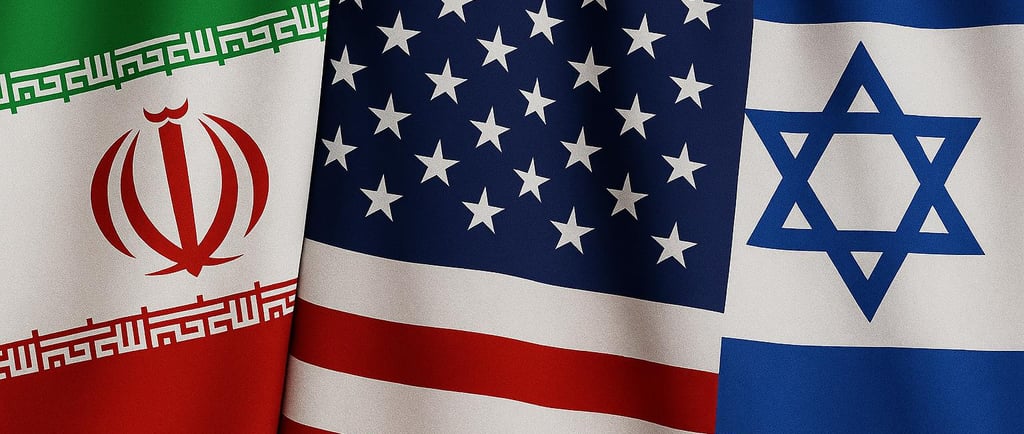
Yet another war broke out in the middle east on Saturday morning, but this time it’s different. It can be difficult to see the forest for the trees, but when we examine recent history, we see that there is a narrative that starts to become clear. This is the next (and hopefully final) chapter in a cold war that became hot on October 7th 2023. This is all part of what should become known as the Israeli-Iranian war.
The predominant players are Iran and Israel. The United States, and now many others have started playing supporting roles. Some quite recently, some for a long while now. Let’s look back and understand how we got here:
On October 8th, 2023, it was clear to many that Israel would need to eventually go into Iran and finally deal with this regime. The Iranian government had been financing terrorism throughout the world and now they had done enough to seriously damage and threaten Israel. They were the benefactors and controllers of a network of proxies including Hamas, Hezbollah, the Houthis, and the Syrian Assad regime.
The attacks of October 7th, and the ensuing Gazan theatre became the first real focal point of the conflict.
The pain and suffering caused by that war was immense and horrible to behold as it was broadcasted online. But Hamas was slowly grinded down and pushed into accepting a ceasefire. They were surprisingly resilient in their survival.
A US backed, Israeli pseudovictory was always inevitable however. The ceasefire was reached and the remaining living Israeli hostages were mercifully returned home last December. Gaza was a catastrophe for Israel despite coming out of that theatre “victorious”. A significant portion of Hamas’s war aims were to discredit Israel and Jews worldwide. The reputational hit to the only Democracy in the region and the ensuing Judaiophobia cannot be ignored. A pyrrhic victory for Hamas though is certainly not enough to count as a win for the Iranian regime.
Remember that in 2023 this was a regime that was the most important player in the middle east. They had far reaching power, and were unabashed in their frequent chants of “death to America”, “death to Israel”, and “death to the Jews”.
The Ayatollah and his government had actively promised the destruction of other states. They were impressively candid about their aims, and only barely tried to obfuscate their connections to their proxies. Iran made it clear that their goal was to eliminate Israel. Israel needed to deal with this existential threat. October 7th demonstrated that waiting was no longer a viable strategy.
Israel could not retaliate right away however, as a full scale war with Iran in 2023 would have certainly been catastrophic. Each proxy was near the height of its powers and had been arming for a decade. Israel needed to be measured and strategic about its response. All out war would provoke a full retaliation - an outcome that likely would have meant serious physical damage to Israel and its population.
So, as the operation against Hamas began to wind down. In southern Lebanon, the Israelis began fighting Hezbollah. At the time, Hezbollah was the biggest physical threat to Israel given its proximity and sheer volume of armaments. The idea that Hezbollah could strike Israel’s north was front of mind. Israel had to conduct such astonishing accolades like the pager and walkie talkie incidents, as well as taking out the Hezbollah leadership in order to avoid serious harm. By late 2024, they had achieved their war aims and withdrew in early 2025.
On Israel’s northeastern front, Syria was long embroiled in a catastrophic civil war but remained actively hostile to Israel. The state of the geopolitical board changed significantly though when Bashar al-Assad was ousted by Syrian rebels - led by the now in power Ahmed Al-Sharaa. While warm Israeli-Syrian relations are still a long way away, the new Syrian regime is occupied keeping its own minority groups in check. This also occurred in late 2024.
Finally there are the Houthis, who while entrenched and proving extremely difficult to remove, have been up to this point unable to seriously impact Israel or the US. They significantly have acted as a dangerous nuisance to the world’s shipping, but their volleys have been managed for the most part without issue. Once the Gazan peace plan was in place in late 2025, they ceased firing.
So the entire axis of proxies: Hamas, Hezbollah, Syria, the Houthis, was systematically dismantled by Israel.
There is an art to the diplomacy and strategy Israel used to navigate this. They were for the most part extremely effective in their individual engagements, logging stark military victories while at the same time never being so aggressive that Iran was provoked into a response. Despite the cacophony of world opinion and reproach for their approach to Gaza, Israel continued to log military victories without retaliation.
The closest it came was in 2024 when Iran launched hundreds of drones and rockets toward Israel after Israel assassinated a senior Hamas leader in Iran. 99% of those missiles were intercepted or redirected, and Israel was given a pretty clear signal that they might just be able to withstand a full Iranian strike.
Fast forward to the summer of 2025 (after Iran had already lost the majority of its proxy network), Israel finally took the step of bombing the Iranian nuclear facilities. As part of that operation, Israel completely defanged Iranian military and anti aircraft capabilities. This did provoke a response from the Iranians but their power had been diminished and their military leverage was for the most part, gone. The success of that operation notably emboldened the American president, Donald Trump, to join the strikes on Iran’s nuclear facility. It also gave the Americans confidence that Iran might just be a paper tiger. Lots of sword rattling, but with no real means to back up their threats.
Seemingly steadfastly committed to their dubious aims, Iran would not back down in negotiations. They publicly declared that they would rebuild their nuclear capabilities, and would never submit to American aggression. Perhaps it was hubris, arrogance, or faith, but the Ayatollah would simply not back down.
Ultimately, as negotiations were continuing to go nowhere, the Americans and Israelis finally decided that they had had enough of Iranian intransigence and began to attack the regime last weekend.
That brings us to where we are today, three days into a conflict that is spreading across the region. It is important to stop and take stock though, that if ever there was a time where Iran would respond with maximum force, it would be now. The Ayatollah has been removed, and the regime is fighting for its life. They say an injured animal lashes out all the more dangerously, but if it is sickly and weak, it can only exert so much force.
Initial reports of Iran’s retaliation have therefore in a sense been encouraging from an American/Israeli perspective. As that retaliation has not caused much serious harm as of yet. That wounded animal may be far older and sicker than perhaps thought.
There are so many pieces to this conflict, parts in the narrative that need to be omitted for brevity, and tremendous fog of war especially in the early days.
But in an attempt to simplify why this action, and why it is happening now. Here are the salient premises:
Israel (Bibi) was able to convince the US (Trump) that now was the best opportunity to take out the Iranian regime given Iran’s current ability to wage war.
The Iranian regime did in fact, need to be taken out.
The first point seems rather self-evident at this moment. That second point is highly debatable and subjective, though. There are many concerns with attacking a regime like this, the most common serious criticism is: what will come next? How can this action be appropriate when there is no plan for succession? History would teach us that when power vacuums such as this exist, they are usually filled by terrorist actors, ISIS for example comes to mind. That is a major concern, and world leaders will need to do their best to facilitate a transition to a new Iranian regime when a suitable candidate appears.
But that fact alone was not enough reason to hold off any longer. It isn’t really possible to have a viable candidate to succeed a totalitarian dictator. It is a prerequisite of the job to eliminate any potential threat. Thus, this argument can only ever be taken into account with probabilities and possibilities.
It is interesting though, that despite no real change in the geo-political landscape for the last several months, that the regime was only toppled after it started massacring its own citizens. That fact signals that morality is indeed at the heart of this operation. That reports of thousands of peaceful protestors being massacred are what finally pushed the US to intervene in Iran really matters.
Ultimately, we arrive at a moment in time where Israel is hoping to finally win the cold war that turned hot on October 7th. The future is yet unknown, but this operation was needed. Now the Iranian regime, the major obstacle to a new order in the Middle East, is finally being removed.
Hope abounds.
Get in on the conversation:
At accordingto.ca, We Believe in Rebuilding the Missing Middle.
If you believe in what we’re doing:
Subscribe. It’s free, and it tells us you’re with us.
Share. If something moves you, pass it on. Help us grow.
Contribute. Know someone who should be writing for us? Tell them. Or tell us.
We’re building something here. And we can’t do it alone.
accordingto
Our mission is to refresh the conversation, and democratize public discourse. We platform smart and spectacular people who are ready to challenge assumptions, explore nuance, and speak with clarity.
Contact
Subscribe
info@accordingto.ca
Discord: https://discord.gg/GUZeHrmZ
© 2026. All rights reserved.