
5 Ways to Have a Better Passover Seder
Jacob Citron on how to make your holiday more meaningful this year.
Jacob Citron
3/19/20267 min read
Podcast Feed
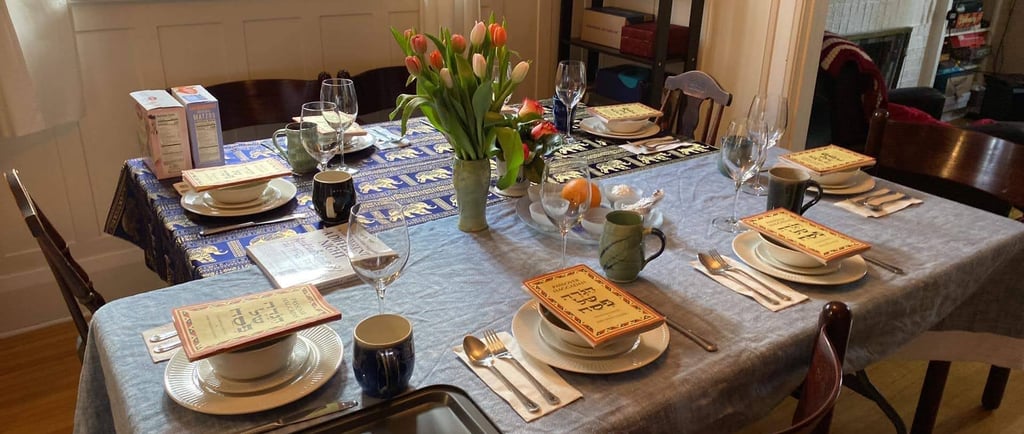
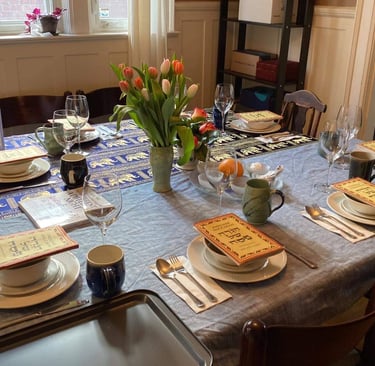
Last year I was invited to give a D’var (speech/address) Torah at my synagogue. It was two weeks ahead of Passover so I decided to take the opportunity to speak on my favourite holiday.
I went through the timeline of all the Passover’s I had experienced thus far. Nights at my grandmother’s place or my aunt’s. I remembered the Covid Seders, and spoke about how the duties of hosting transfer across generations. Finally I remarked on what it’s like now that my partner and I are being asked to lead seders and family dinners of our own.
As this responsibility transferred over, I spent a lot of time thinking about how to make Passover night meaningful. I wanted to pass these pieces of knowledge along, in the hopes of making the experience better for the hosts, the guests, the grandparents, the grandkids. Here are the five key ideas you should think about.
1. The Order
The word Seder means “order” in Hebrew. Passover is fundamentally an exercise in following a guidebook, the Haggadah. The big secret is that they all start with a table of contents. There are 15 steps outlined right at the start. These signposts are the shortcut to a successful evening. 15 might sound like a lot, but when you examine the steps, it makes the seder a lot less daunting. It also will give you the room to focus on what matters most to you and your family. Here’s the list:
Kadesh (Sanctify): The First Cup of wine.
Urchatz (Wash the hands): Wash em.
Karpas (Vegetable): Dipping a green vegetable in salt water.
Yachatz (Divide): Break the middle matzah; hide the Afikomen.
Maggid (Telling): Telling the Passover story, the second cup.
Rachtzah (Wash): Wash the hands.
Motzi (Blessing): Bless the matzah.
Matzah (Eat Matzah): Eat the matzah.
Maror (Bitter Herbs): Eating the bitter herbs.
Korech (Wrap): Make the"Hillel sandwich" of matzah and maror.
Shulchan Oreich (Set Table): Eat!
Tzafun (Hidden): Find and eat the hidden Afikomen.
Barech (Bless): Grace after meal and the third cup.
Hallel (Praise): Sing some songs, drink the fourth cup.
Nirtzah (Accepted): Closing the Seder, "Next Year in Jerusalem!"
It may seem like a lot, but if you examine the steps before # 11 (Eat), you realize you can do all of these in five minutes save for #5 - telling the passover story. So we can really simplify all the mini rituals, if you’re overwhelmed you can have these as boxes to check.
Telling the exodus story is the most important part of Passover. It doesn’t have to be told in the same way every year though. This is a huge opportunity to get creative. There are many ways to go about this. You can have mom and dad tell the story off the top of their heads or present it as a multiple choice test like “Who Wants to Be a Millionaire?”. You can have AI draw a summary up for you in 300 words or less. You can throw on a clip or two from the Prince of Egypt. It’s really an opportunity to get across the message that
A) we were slaves in the land of Egypt
and
B) We were redeemed, and brought out of Egypt.
Of course the more we can explain the better, but if your family has short attention spans, it will be a better holiday for everyone involved if you switch up how you tell the Passover story.
Steps 13-15 can be done however you best see fit. Drink the wine, say thanks. Once you realize the structure of a passover seder is that simple, you can start to feel a lot better about conducting it.
2. Focus and think deeply on making the night relevant and meaningful
Take a moment and consider. What is the point of this holiday? Why do we have to tell our kids every year the same old story? For me, it is a reminder that we were slaves, and therefore we need to have tremendous gratitude that today we are free. Further, we must remind ourselves to have empathy towards those who are not free. This is the message I distill from Passover. Your key message might be different. Yours might be that this is a story of Jewish continuity, and Jewish resilience. A historical reminder of the fact that we’ve been around a very long time, or perhaps a nod to the constant presence of Judeophobia.
In other words, determine what the holiday is actually about for you and your family, and then think about how to make your Passover communicate that point and those values to your guests.
It is also worthwhile to consider who is going to be at your table. Are the people old? Are they young? Are they observant? Are they the kind of people that want to get straight to the part where we eat? Are there maybe some non-Jews there? Once you have those answers, you can customize the evening to best serve your guests.
3. Reminisce a Little
Close your eyes and think. What was the best seder you were ever at? Who was there? Why was it so good? What made it memorable? If you can identify why those memories have stayed with you, it is a phenomenal hint to getting your own seder in order.
Think about what traditions might have been lost. The stern negotiation for the afikomen perhaps. Or your family’s favourite song (Youtube exists, search it up!). Maybe it’s really insisting that folks do their part and finish all the cups of wine. Honour the past, and find the lessons there.
A simple but lovely idea to try: When you’re doing the four questions, before the youngest person recites Ma Nishtana, ask the oldest person in the room what their first Passover memory is. Ask them to describe how it’s the same and how it’s different. They might start telling a story you had never heard, open a window to an ancestor and one of their quirks. Either way, if your grandfather is talking about his grandmother, that might be over a hundred years of Jewish experience. Who knows, maybe they will be able to give you some wonderful ideas for next year as well.
4. Get a New Haggadah.
If you’re anything like me, then you grew up with the same red and yellow Haggadah that’s been around since the 1950s or earlier. It certainly served a purpose, reading in turns around the table in a monotonous voice, talking about what rabbi so-and-so thought the meaning of that specific word was. Debating how many fingers meant how many plagues. My eyes are glossing over just thinking about it. Not to knock the hardcore talmudists.
This might blow your mind, but there’s no rule that says you need to use that book anymore.
Many publishers have released Haggadot for the modern era. There are whole websites devoted to it. My favourite these days is called “A Different Night” which has many excerpts and guiding passages for seder leaders and participants. It’s not too late to order a book for this year or for next year. Not everyone necessarily needs a copy either. You can do what you’d like to make the holiday meaningful. Maybe print out a key passage or two.
The takeaway here is to be deliberate about your seder. A haggadah is a guidebook, and you should be equipped with a guide that serves your version of Passover in 2026.
5. Try something new
Traditions are fantastic, but they all start somewhere. Maybe this year is the year to start that new tradition. If you can’t think of any, the Internet is chalk full of ideas to get you started.
Here are some off the top of my head: maybe have each guest bring something that symbolizes one of the plagues. Maybe send a fancy invitation using Canva, or send a question out ahead of time like “what are you grateful for this year?” This night is different from all other nights, after all.
You can try to abstract what the four archetypes of the children are. You can engage your guests to think about what a wise, contrary, simple, and unable to ask person is in the context of Judaism in today’s day and age.
Maybe sing a song that reminds you of Freedom. Or throw the Rugrats Passover special on the TV in the family room. Bring back the chametz hunt the night before, or try reading a prayer in Hebrew.
The key is to try. Because when you put the effort in you’ll get more out, and you might even find yourself really enjoying the evening.
In the End
Passover has always been my favourite holiday because I have been able to focus on the meaning behind it. I examine it through that lens of meaning. What does this mean? For me, it is to remind us to have gratitude and empathy because we were slaves in Egypt. We need to remember what that was like so that we can remember the lessons learned in bondage. We need to honour that past, and consider what it is like to not have freedom in our modern world. You can think about what freedom is or isn’t to you. I like to consider how lucky we have it, despite all the chaos and hardship going on with Judeophobia at an all time high, this is still one of the best times every to be a jew.
That’s just my interpretation of the thing however.
The salient question is, what does it mean to you?
Chag Sameach
Jacob Citron is the editor in chief at accordingto.ca. During the days he owns and operates a Life Insurance brokerage. He started accordingto to restore the missing middle. Get in touch, he'd love to hear from you.
Get in on the conversation:
At accordingto.ca, We Believe in Rebuilding the Missing Middle.
If you believe in what we’re doing:
Subscribe. It’s free, and it tells us you’re with us.
Share. If something moves you, pass it on. Help us grow.
Contribute. Know someone who should be writing for us? Tell them. Or tell us.
We’re building something here. And we can’t do it alone.
accordingto
Our mission is to refresh the conversation, and democratize public discourse. We platform smart and spectacular people who are ready to challenge assumptions, explore nuance, and speak with clarity.
Contact
Subscribe
info@accordingto.ca
Discord: https://discord.gg/GUZeHrmZ
© 2026. All rights reserved.