

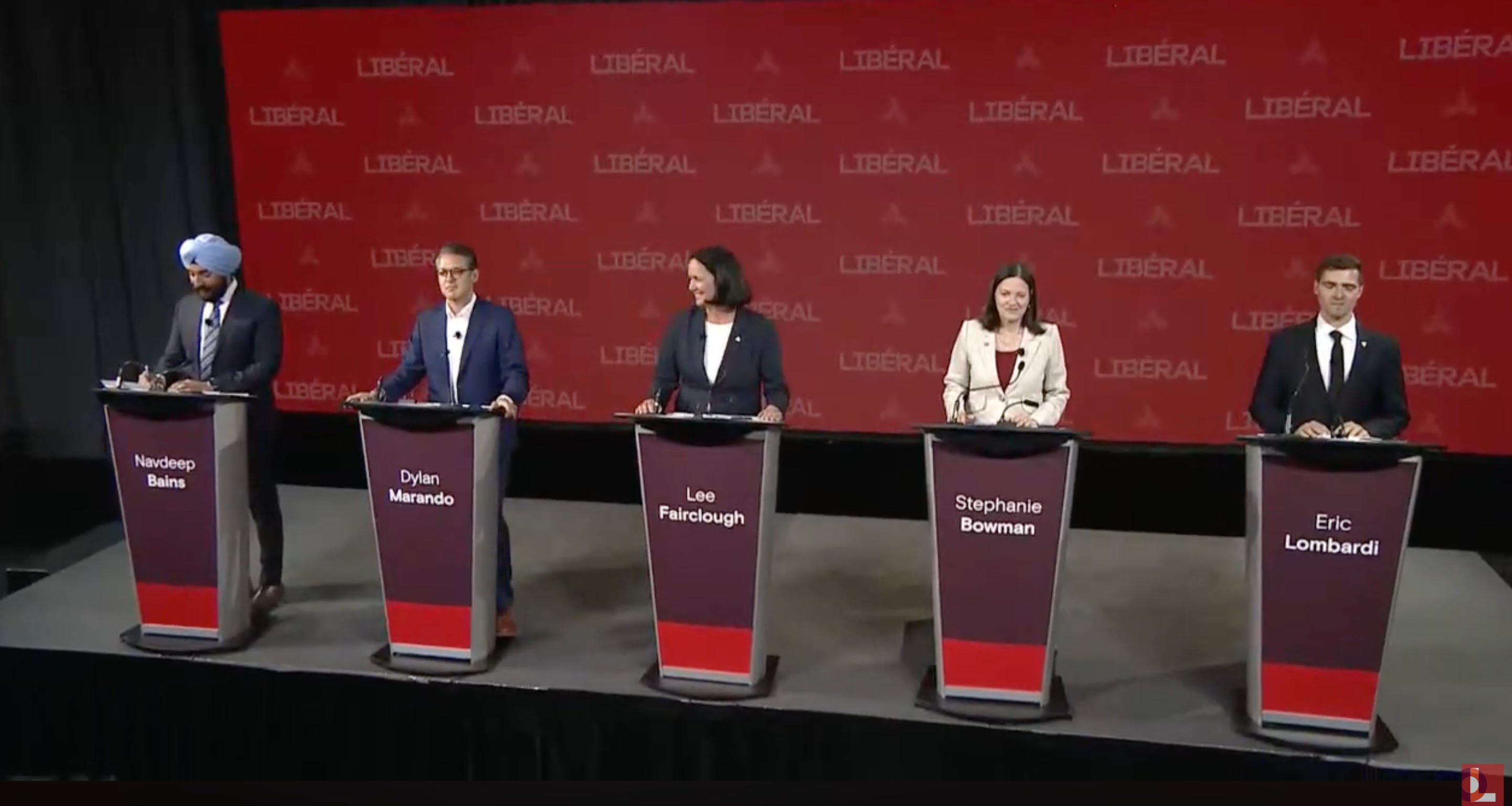
The second Ontario Liberal leadership debate took place on Monday, and the race has remained in relative stasis. A month has passed since the first debate, and if you stitched clips from the two side by side, you’d be hard pressed to tell the difference.
Navdeep Bains, Lee Fairclough, Dylan Marando, Stephanie Bowman and Eric Lombardi all have strong individual cases to become leader, and a lot could change in Ontario once one of them grabs the reins of the party.
The election is just six weeks away. The membership drive is over, which means candidates can now focus solely on winning the hearts and minds of declared Ontario Liberals. The opportunity exists for a candidate to break away, but so far all five hopefuls are seemingly sticking with the peloton.
It’s a tricky landscape, as these events are still barely visible to the public. Viewership for the debate peaked at about a thousand people on YouTube. The August debate is still at only thirteen thousand views, neither event was exactly primetime programming.
There’s been a good deal of justifiable criticism lobbed at the mainstream media for not covering this leadership race, but the OLP can’t make that an excuse. If they aren’t relevant, they need to make themselves relevant to have a chance at winning back Queen’s Park.
In defence of the media, both debates have been a tough watch. The format is fine in theory, but the presentation is bland and makes it really difficult for candidates to manifest their charisma. Further, in hindsight the OLP might wish they had picked a different time to hold this race. Municipal elections are heating up across the province, and those races are taking all the non-trade-war political oxygen out of the room.
It’s a tough task to drive emotion when you’re speaking to an empty room. It’s rather reminiscent of the worst parts of COVID conferences, where the space feels cavernous and grey.
As far as who won, again, no one really. Most of the trends from the previous debate stuck, so readers looking for a more in depth breakdown can check out our debate review from August. The most prominent theme remains that the candidates seem more interested in criticizing Doug Ford and the Progressive Conservatives than each other.
The result is that practically no one watching will have felt like this debate moved the needle.
Strategically speaking, that might be a consequence of the election’s format. The actual vote is going to be a ranked ballot, which means if a voter’s primary choice is out of the running, their votes get redistributed based on whoever they put second on the ballot, and so on. Candidates can have confidence they have signed up their loyalists, but none has anything close to a majority, nor does it seem they will approach one.
This means that, fundamentally, whoever gets the most second-place votes will likely become the Ontario Liberal leader. Making enemies out of a rival and their base could therefore have disastrous consequences.
The format makes it natural for the candidates to be hesitant to bash each other. There’s a bit of a standoff, though: none of them seems to want to draw first blood for fear of reprisals.
Lombardi did try and push the issue a little. He challenged Bains on his lack of a plan. Bains maintained he had one, but never actually explained what it was. That was by far the spiciest section of the debate, as low a bar as that is.
Moderator Siobhan Morris did well given the vanilla circumstances but could have pushed to find wedges between the candidates. The challenge is that, for the most part, the three more experienced candidates seemingly agree on every policy. Marando has come out with some interesting and novel ideas like a different tax rate in Northern Ontario. Lombardi has a fully fleshed-out set of policies, costed and publicized, but this debate format isn’t conducive to communicating them in succinct ways.
A creative candidate might be able to leverage this format. If they spent less time bashing Ford, they could appeal to their rivals’ bases with a relatively simple yet explicit pitch: “I don’t need to be your first choice, but I should definitely be your second. Here’s why.”
At this time, Bains, Fairclough, and Bowman seemingly still have the hammer based on name recognition. Marando and Lombardi do still reasonably have paths to win this race, they will need to inspire a hunger for change among a largely establishment boomer party base. It is certainly possible though, if for no other reason than the nomination format.
The end result is that this election still does feel wide open. Given that the winner will be one step away from shaping the lives of sixteen million Ontarians, it’s worth paying attention to. In the meantime, it will be fascinating to see how things unfold. Perhaps a big move is waiting in the wings, but for now, it appears the candidates are all still analyzing the election math to see if the potential risks of going on the attack are worth the reward.
Another great analysis, Jacob.
As I just wrote on Facebook, I’m glad to have the info without having to watch.