
Aging Student Body
What going back to school at 37 has taught me about Canada — and why I came back to the classroom
Jeff Greenberg
3/19/20267 min read
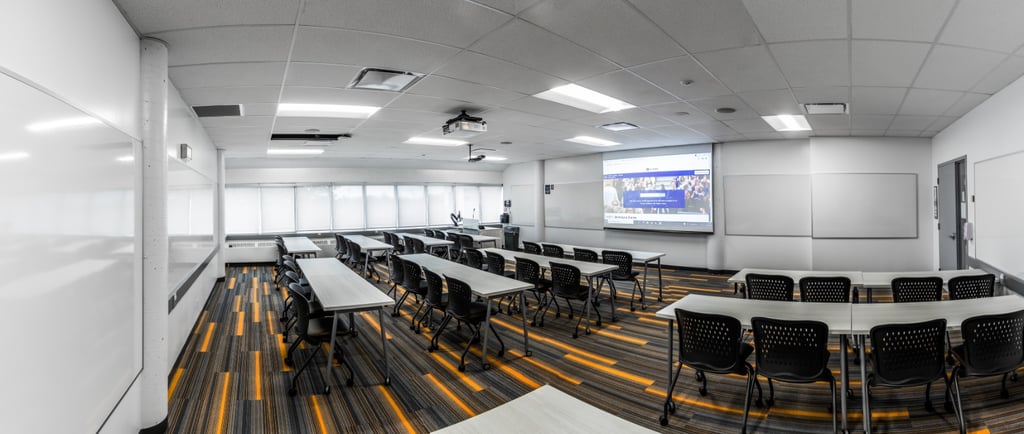
I didn’t expect to be the oldest person in the room. Not by much, at least. When I enrolled in Humber Polytechnic’s postgraduate Data Analytics program last September, I had a vague mental image of returning students — people mid-career, pivoting, re-skilling. People like me. What I found instead was something far more interesting, and far more instructive about the country we live in.
I’m 37. I have two young kids and a mortgage and a professional life that needed redirecting. I graduated from the University of Guelph in 2011 with an honours Bachelor of Arts and Sciences — a degree I’m proud of, even if the world I graduated into looked nothing like the one I was prepared for. Fourteen years later, I’m sitting in a classroom again, trying to become someone who can speak fluent data. The experience has been humbling, clarifying, and at times quietly surreal.
It’s also been a window into something I didn’t anticipate: the complex web of motivations that bring people to a program like this, and what those motivations reveal about Canada in 2025.
The room I walked into
Out of my entire cohort of sixty, there have been three domestic students. Three. I am one of them. Of those three, only two of us are Canadian. The rest of my classmates have come from India, the Philippines, the UAE, and a handful of other countries.
This is not a complaint. I want to be clear about that. Many of my classmates are sharp, driven, and genuinely curious about the material. Others are trying their best in their second or third language. Even still, I’ve learned things from them in casual conversation that no textbook could ever have offered me. The experience with my cohort has fundamentally changed the texture of what it means to be a student in this program and in this country for me.
I am, by almost every measure, the outlier. That’s a strange thing to be when you’re attending school in the city where you grew up.
Two different programs inside the same one
Here is the hard truth I’ve come to understand: most of my classmates are not here for data analytics. They are here for permanent residence.
That’s not a cynical observation. It’s just true, and most of them will tell you so directly if you ask. Canada’s immigration system, for a period at least, treated postgraduate study as a viable pathway to a work permit and eventually PR. Enrollment at an accredited polytechnic in a designated field checked the right boxes. The program content was, for many, secondary to the credential itself.
I won’t ever fault anyone for this. The desire to build a stable life in a country that promises stability is not a character flaw - it’s entirely rational. Canada has sold itself as exactly that destination for decades, and people have responded accordingly. But it does mean that I am in a classroom where a significant portion of my peers are operating with a fundamentally different set of stakes than I am, my experience aside.
I’m here because I want to transition careers. I’m sitting in a classroom at 7:40AM three times a week after a 35 minute drive because I want to be competitive in a labour market that increasingly requires technical fluency. I’m here, if I’m being honest with myself, because I felt left behind and didn’t want to feel that way anymore. That urgency is real, but it’s different in kind from the urgency of someone whose legal right to remain in the country is contingent on academic standing.
We are all, nominally, in the same program. We are not, in any meaningful sense, in the same situation.
Studying in 2026
In 2011, studying meant reading. It meant flashcards and highlighters and the occasional all-nighter with coffee and a textbook that cost $140. It meant memorizing concepts and pages that would immediately dissipate when that final scantron bubble was filled in. It meant being physically present in a library for hours and hoping the person at the next desk wasn’t a snorer or a mouth-breather.
In 2025-2026, studying means something considerably different.
I use AI tools constantly. Not to do my work for me - that’s a distinction worth making, even if the line is blurrier than most institutions want to admit - but as a thinking partner. When I’m trying to understand a new concept in Python/SQL or wrap my head around a statistical method that wasn’t in the assigned reading (simple exponential time-series forecasting, perhaps), I open a conversation and start asking questions. The quality of the explanation I get is often better than what I’d find in a tutorial, and it’s infinitely more patient.
The true gamechanger for me has been using AI to generate practice exams. I describe the topic, the format and try to approximate difficulty. I upload my annotated lecture slides, and I get three sets of questions that prepare me for what’s coming - foundational, intermediate, and advanced. I can quiz myself until the material sticks, at eleven o’clock at night after the kids are in bed, without needing anyone else’s time or resources. For someone with my schedule, that’s not a convenience - it’s a lifeline.
The result, so far, has been strong grades. I’m performing well. Whether that reflects genuine mastery or clever use of available tools is a question I think about more than I’d like. My honest answer is both. And I’m not sure the distinction is as clear as it used to be.
What’s at stake for me
I don’t have the luxury of taking this easy.
When I was an undergraduate, failure had a recoverable quality to it. A bad semester meant a bruised GPA and maybe a lecture from a parent. There was time. There was always more time. That is not the texture of my life right now. I have two children. I have a partner whose career demands are real and significant. I have financial obligations that don’t pause while I figure out whether I’ve chosen the right path. Every assignment I submit, every exam I sit, carries a weight that a twenty-year-old version of me would not have recognized.
There is a particular kind of pressure that comes from being a parent who has voluntarily stepped off a career path to take a risk. You believe in the bet you’re making, otherwise you wouldn’t have made it. But belief and certainty are different things, and at 11 PM on a Tuesday, when you’re debugging code you don’t fully understand while listening for sounds from the baby monitor, certainty can feel a long way off.
What keeps me going is not confidence. It’s not momentum. I’m reminded whenever I kiss my wife’s sleeping head before leaving early. When I finish the next big Disney movie with my daughter and see her smile. When I successfully lift my soaked thirty-two pound baby boy from the bath. I continue, knowing that the end will bring blessings I don’t always feel I deserve. There is no stronger inspiration.
What this has shown me about Canada
There’s a version of this experience that reads as a complaint - “Canadian student feels out of place in his own country’s classroom, laments the diversity he didn’t ask for”. That’s not what this is.
What I’ve found is a vivid, human-scaled illustration of the tensions Canada is currently navigating at a national level. This country has built an immigration system and a post-secondary sector that are deeply intertwined, in ways that are not always visible until you’re enrolled and making the pilgrimage across the frozen tundra of the Humber Hawks’ football field weekly. The students in my program are not abstractions in a policy debate. They are people, with specific histories and specific reasons for being here, who are trying to make a life.
At the same time, there’s something worth naming honestly: a postgraduate program that is functionally structured around immigration incentives rather than labour market outcomes is not, in the long run, serving anyone especially well. Not the students chasing a status they may or may not achieve. Not the domestic students trying to build professional credentials. Not the institutions whose reputations depend on those credentials meaning something.
I’m not sure what the fix is. I’m a data analytics student, not a policy analyst. But I’ve had a front-row seat to the gap between what these programs promise and what they actually deliver, and that gap is worth paying attention to.
What I’m taking from it
I am, against all odds, enjoying this. That surprises me more than anything else.
There is something about being a beginner again. About struggling with material that is genuinely hard and not yet knowing whether you have the capacity for it. I forgot what that felt like. I forgot how much I used to learn from the friction of not knowing. From the space and time in-between. University was, after all, so much more than just education.
The tools have changed. The pace has changed. The stakes have certainly changed. But the basic experience of being in a room with people who are trying to build something - a career, a credential, a future, a life in a country that promised them something - is recognizably human. That part hasn’t changed at all.
I have a couple months left in this program. I intend to finish it well. What comes next is genuinely unclear, and I’ve made a kind of peace with that. For now, I’m just the oldest guy in the room, quietly taking notes, trying to figure out what I want to be when I grow up.
More on this to come.
Jeff Greenberg is a Toronto writer, proud early voice at accordingto.ca. He writes about Jewish identity, parenthood, career reinvention, and pop culture — and when he's not doing that, he's deep in an RPG on Switch, hunting rare rock posters, or at an indie or jam show. His best hours are spent with his beautiful kids Abigail and Jonah, and wife Naomi.
Get in on the conversation:
At accordingto.ca, We Believe in Rebuilding the Missing Middle.
If you believe in what we’re doing:
Subscribe. It’s free, and it tells us you’re with us.
Share. If something moves you, pass it on. Help us grow.
Contribute. Know someone who should be writing for us? Tell them. Or tell us.
We’re building something here. And we can’t do it alone.
accordingto
Our mission is to refresh the conversation, and democratize public discourse. We platform smart and spectacular people who are ready to challenge assumptions, explore nuance, and speak with clarity.
Contact
Subscribe
info@accordingto.ca
Discord: https://discord.gg/GUZeHrmZ
© 2026. All rights reserved.