

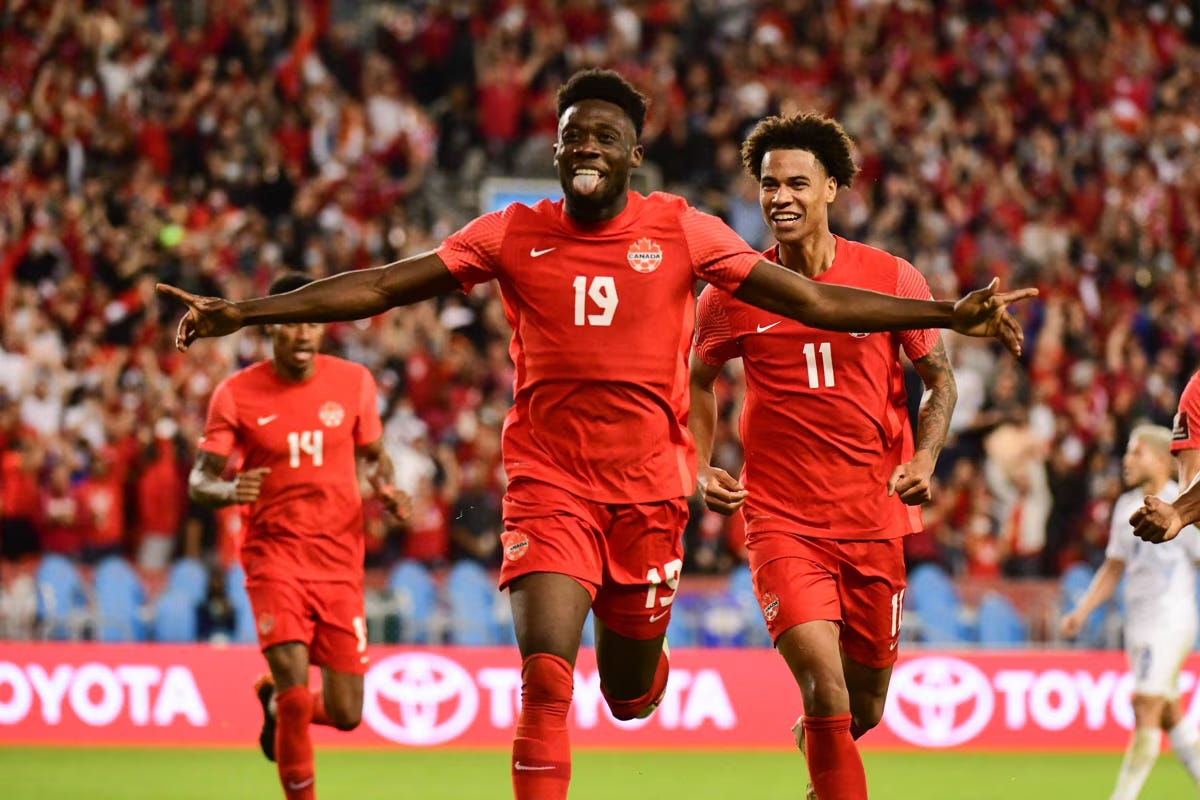
The World Cup is coming to Toronto this week. If you’re from away and curious about the most junior partner in this tournament, or simply a Canadian who hasn’t been paying attention, then this article is for you.
Like so many Canadians, soccer (football) has been a key part of my entire life. I played growing up, but I can trace the moment I got hooked on the beautiful game back to 2004. I was twelve years old, and my father had just passed away. While our family was grieving, I found a temporary escape watching the European soccer championships in the basement. I am half Portuguese, and Portugal made it all the way to the finals that year. Retreating into soccer and connecting with that part of my heritage was like therapy getting me through the hardest stages of bereavement.
There are a million unique Canadian stories like this. Powerful moments connecting Canadians to their childhood, to their families, and to their cultural heritage through this one global sport. Canada is a country of immigrants. Toronto, its biggest city, especially so: More than fifty percent of Torontonians were born outside of Canada.
Most Torontonians have steadily fading connections with our countries of origin, but we can temporarily re-atune through the World Cup. We don’t necessarily know, hear, or see the geopolitics in our homelands, but we know who the best footballers are. For example, most Portuguese Canadians couldn’t tell you if Portugal has a Prime Minister or a President (They actually have both). But they certainly all know about Cristiano Ronaldo.
Prior to 2022, Canada simply wasn’t a legitimate international outfit. That meant that most Canadians could easily keep a firm attachment to the old country when it came to soccer. There was no local competition. Immigrant families woke up early and booked time off work to watch their countries play on the international stage. Argentinian, French, South Korean, etc. In a country of immigrants, everyone is from somewhere.
Toronto is the frontier for maintaining distinct cultural enclaves while part of a national whole. This is the proving grounds for the Canadian experiment. Finding a paradigm wherein those cultures can be nurtured, emphasized, and folded into the fabric of the nation’s greater cultural mosaic. All this while working towards the higher goal as laid out in our constitution: peace, order, and good government.
The key to living together in this way is generally staying humble, and keeping the cultural demonstrations to the background (notwithstanding your one assigned weekend for a heritage street festival). In that sense, the World Cup has always been a moment where people are allowed to simultaneously let their hair down a bit and go a little wild, drinking their Peroni, Guiness, or Raki.
International soccer tournaments are a sudden desert bloom in the concrete jungle of Toronto. Partisans get to show off their heritage in a way that just isn’t typically done in Canada. When June hits, you will notice flags flying from every country in the world on the hoods of cars, in restaurant windows, and on apartment balconies.
It’s a glorious feeling to feel like you are in the centre of the universe, as if everyone was there all at once. The world comes to us, and we can go and experience a sampling of the world. Toronto has distinct cultural neighbourhoods that become hubs for supporting national teams, and emphasizing cultural traits. Little Jamaica, Little Italy, Little Portugal, etc.
The cultural enclaves, spanning a few blocks, are also evidence of a chronology of individual diasporas. The neighbourhoods are little time capsules that hint at the waves of newcomers adding and adding to the fabric of the country over decades.
Canada doesn’t have grand botanical gardens, castles, temples, or monuments. But we do have a little bit of everything, and that is extremely special in its own right.
When you combine these rich heritages with the fact that the Canada team was feckless for so long, most soccer fans support their grandparents’ teams. Therefore, if Argentina was playing Canada, Argentinian-Canadians would rather Argentina win. For me, the greatest sporting moment in my life thus far was when Portugal won the Euros in 2016. This is a common sentiment. I would be extremely hard pressed to pick a favourite if Portugal played Canada in a meaningful game.
This is the first thing that someone from away really needs to know: Canada is most Canadians’ second favourite team.
The next thing to be aware of, is we’re having a bit of an identity crisis at the moment. Pinning down a Canadian identity has always been difficult. We have an immense geography — Canada is bigger than the entirety of mainland Europe combined. This means that it’s a challenge to find commonality with people living in the north, in French Canada, or on the coasts. Our motto is “Mari Usque Ad Mare” “From Sea to (Shining) Sea”. Between those seas, there is a lot going on. One thing we tend to have is this idea of humility. Humility is a guiding principle for Canadian character — we typically don’t like to show off.
You may notice that internal circumstances are a little tense. So much so, that two of our provinces (there are 10) are currently actively discussing leaving Canada. We have trouble agreeing, to say the least.
One thing we can agree on however, is that we are in a bit of a fight with our next door neighbour. You may have heard, but the president of the United States — he who shall not be named — has been messing with our minds and wallets. So much so that his threats to annex the country last year completely reversed the direction the country was going politically. People are worried about the impact of the trade war, and saliently they feel slighted. Because by all accounts, we think that we have been excellent neighbours.
Then this past week, the Prime Minister had to get up in front of the entire country and explain why it’s not okay to hate Jews. So yeah, there’s some stuff going on.
Despite all that, Canadians still feel like we live in the best country in the world. We don’t tend to do riots or civil strife (at least not yet). There is nowhere any of us would rather be. We do tend to feel like we’re superior to America, and there’s an impetus to prove it. It is our duty to politely welcome you, and treat you like the valued visitors that you are. Guests are going to have a great time, despite any background problems.
But the second thing you’ve got to know about Canada is that we’re kind of going through it right now. For many of us, hosting this world cup feels like when you are hosting a party but haven’t started cleaning the house soon enough. As a solution, you throw all the dirty laundry into that upstairs bedroom and keep doors closed and everyone downstairs. The guests aren’t going in there, but the host still feels guilty and unprepared. We’re sorry for any inconvenience.
As far as the actual game, soccer is Canada’s most played sport, but it is by no means the most popular to consume - that would be hockey.
This is partly due to the fact that Canadian soccer history has been disappointing to say the least. Prior to this year, Canada has qualified for two world cups. We’ve played six games. We’ve lost them all. We have scored two goals (One by us, one an own goal from Morocco).
Despite that, Canada’s men’s program is actually in its golden age.
The Canadian roster is made up of legitimate world class players. Men who play for big teams in top leagues — Germany, England, Italy, etc. We are a serious team. Canada isn’t necessarily a threat to win the whole tournament, but we’re not just happy to be there anymore either. This is a stark departure from the dark ages that were the 2000s and 2010s. For the first time ever, there are real expectations. Which means that there is potential for disappointment. The games are interesting. They need a win to kick it off.
And so we arrive at Friday’s opening match of the World Cup. Canada vs Italy Bosnia-Herzegovina.
Off the pitch, there is real promise to what this World Cup can bring: a safe environment for us to dip our toes into nationalism, something we are highly uncomfortable with. Canada Day (which falls exactly within the tournament window on July 1st) is never marked by big rallies in seas of red and white. We celebrate by enjoying a day off of work and savouring our short summers. Few Canadians have ever been to a Canada Day party. We aren’t oriented that way, our Protestant roots discourage outward passion.
That’s the last thing you need to know. Canadians are not going to lose our minds for Canada. Our people are not going to go all in, not at the start at least.
Those are the real stakes of the World Cup for Canada: Whether or not Canadians can go all in for the home team.
This World Cup has a chance to be a flash point, a unifying moment wherein our people can come together with real positive purpose. We can be unifying towards something instead of away from something. In other words, we have an opportunity to proudly unite around being Canadian, as opposed to our default mode of “At least we’re not American.”
So, on Friday, eleven young men — most of whom are immigrants or sons of immigrants — will take the field to represent a country of immigrants. This isn’t just their opportunity to make sports history and finally win a game: they could be the match that ignites a fire: inspiring a country and reminding us all what it actually means to be proud of Canada, and to feel profoundly Canadian.
It can go either way. We’ll see how 40 million react. Welcome to Canada, and we’re sorry if it isn’t what you expected.