

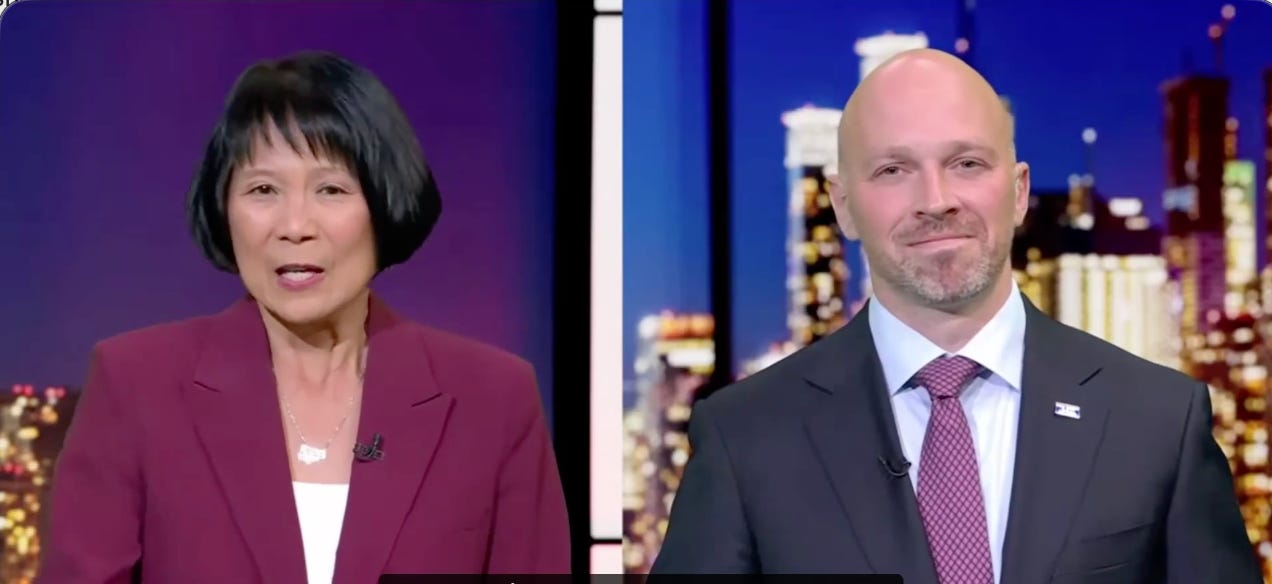
Who says politics is boring?
The 2026 municipal election campaign was the first in my life that I was paying close attention to. I was invested enough that I could name the major two or three candidates for council in just about every one of Toronto’s 25 wards.
There were moments where I truly believed Brad Bradford was going to be our next mayor. But I am a massive Toronto Maple Leafs fan, so let that tell you what I know about predicting winners and losers.
There is a paradox at play when anyone is too close to certain matters: the people nearest to them have blind spots. When you have the context and know the full story, you assume everyone else does too. I certainly fell victim to it this time around.
There were many reasons that Olivia Chow won and Brad Bradford lost. As the post-mortems begin to be written, there are two key connecting threads that stand out as particularly large factors. First, how issues and narratives about the campaign were framed, and second, how the political organizations backing the candidates were practically and logistically driving the framing of those narratives. Political parties aren’t supposed to exist in municipal politics in Ontario, but practically speaking they do, and that could be the most impactful reason behind why Chow won.
Perception vs. Reality
A simple truth about democracy is that the skill of being elected is not the same as the skill of governing. Politics is a lot about managing the difference between the perception of how one would govern and the reality of how that person does govern. Convincing people who to vote for doesn’t have to be about airtight arguments. This is not a shocking truth, but it does get overlooked. There’s a reason political organizations work the way they do, and a reason the people who win elections, win them.
Interest in Toronto municipal politics is low. Most citizens will already have forgotten there was an election this week. For proof, run a simple test: ask people today who their city councillor is. Would even one in five know who they voted for, let alone who now represents them just a day or two after the election?
So the people and the issues aren’t what’s motivating voters. For a municipality, the issues are too complex and in the weeds. The exact amount of money saved with a fare cap over a year isn’t so relevant. The idea that a fare cap is a win for the urban poor is something you can sell. People respond to good stories and to effective storytelling.
Good stories don’t always care about the finer details of the truth, and every candidate in every election will stretch the truth at times.
In this municipal election, however, one side was far more effective at telling their story and pushing their narrative. For example, if you actually know anything about Brad Bradford, you know he’s a centre-left politician. If he were to run provincially or federally, he would land squarely in the Liberal Party. Yet the Chow team managed to paint him as some kind of right-winger. This was the same tactic used to graft Trump onto Pierre Poilievre as “Maple MAGA” in last year’s federal election, and it worked well to diminish Bradford’s reputation.
It isn’t true, but people will inevitably believe these sorts of things if they are not properly dispelled. Ultimately, Bradford’s campaign did not have a good enough response to those accusations. That tactic worked because there was no centrist organization prominent enough to rebut it. The attacks were partly coming from the mayor’s campaign, but they were more importantly being amplified by the political machinery surrounding the left in Toronto.
For example, on the matter of creating a public water utility, spinning up a new utility seemed like a reasonable decision and sound plan. Like anything, it has its tradeoffs. It should have been a nothing-burger about city governance. Yet somehow the notion that the move would lead to privatization and a sell-off of the water (which is illegal) took hold of hearts and minds. That is a powerful story, even if it is fantasy. Simply suggesting that potential scenario scares people.
Of course, for those paying attention, the complete and total irony in this particular instance is that as this became the Chow campaign’s attack tactic, Chow was accepting an endorsement from Kathleen Wynne, who is infamous precisely for privatizing a major public asset. It is strategic and logical incoherence, but it was not punished.
Mayor Chow and her campaign said explicitly that she was concerned for the safety of Toronto’s water. In other words, the accusation was that Bradford was essentially going to poison the water. This was simply a lie that was allowed to spread.
Bradford did the honourable thing and tried to counter by saying these lies were beneath the mayor. But his message did not reach the public, and many voters, getting only some part of the story, were concerned about an impossible reality.
This tactic is made more effective because of how its signal gets amplified. People hear one side without hearing the other, and in this instance, people were motivated more by fear than by facts and logic.
This speaks to the fact that the Chow side was willing to play a little dirty, and they were able to do so with help. Now, this is nothing illegal, nor is it particularly irregular to be slinging some dirt in an election campaign, but those negative tactics aren’t exactly aligned with the progressive values their authors claim to espouse.
On the water file, for example, Chow quoted lawyers who are closely enmeshed with her camp as “legal experts.” Those “legal experts” claimed that Bradford’s plan was “opening the door” to privatization. This is something they are well aware could never actually happen. However, these “legal experts” (notice how the campaign doesn’t use a dirty word like “lawyer”) hedge with the word “could,” so the claim could technically be sound. It is a fabricated idea made impervious by being couched in soft language. On the other hand, extrapolating that into a full-on “he will poison the water” is absurd and an emblematic version of the slippery slope fallacy. The lesson: those dirty tactics work.
Another clear example of the double standard coming from the Chow camp was that they successfully portrayed her as an anti-data-centre candidate when her record and her own words clearly show that she is in fact pro-data-centre. Chow said clearly that she was putting a “moratorium” on data centres, and would not give an answer when pressed. She was “looking into it.” Again, that’s technically true, but a more ruthless opponent might have attacked Chow for this. She was trying not to alienate her base.
In hindsight, the Bradford campaign might be wondering if they should have played a little dirtier. More Florida Panthers and less Edmonton Oilers.
Efficacy of the tactics themselves aside, just as vital an issue for Bradford was that there was no significant background political apparatus backing him. His campaign was living in 2016, when individuals ran for mayor. The Chow campaign, on the other hand, was firmly living in the 2026 world, where politicians need sophisticated backing from organizations.
The Machinery of Elections
To understand the basics of election campaigns, politicos bifurcate elections into two segments: the “air game” and the “ground game.”
The air game is what you see on television and social media, in mailboxes and flyers and advertisements. Chow won the air game because her team and her backers at Progress Toronto (more on them below) expertly leveraged the resources available to them. They used social media better. Their negative messaging was more powerful than Bradford’s attempted messaging of hope. They were able to paint Bradford as a right-wing villain on TikTok and in mailboxes. The irony, of course, is that Chow’s campaign created a false narrative that Bradford was catastrophizing the state of the city, while simultaneously employing messaging that catastrophized a potential Bradford mayoralty. Another dirty but effective tactic.
None of this was effectively done face to face either. The debates, it seems, more than ever, simply don’t matter. No one really watches them anymore. A quick check on YouTube shows that each debate currently has only about fifty thousand views. If people took the time to watch them, they would see that Bradford wiped the floor with Chow.
In every single debate, he was better spoken. He knew the issues more intimately. He knew the policies more intimately. He was able to answer the questions. None of it mattered.
Therein lies the lesson about the modern air game: debates are increasingly insignificant. Voters are consuming their information in separate, customized algorithms on Twitter and Reddit and TikTok. Savvy candidates need to adjust to that.
While the air game is the hearts and minds, the ground game is the practicality of people’s feet, all in the service of getting voters to the polls. In federal and provincial politics, this is typically done by party machinery, but there is supposed to be an embargo on party politics in Toronto.
While that embargo is technically upheld, there is far too much at stake in Toronto’s elections, and clever organizations like the NDP and labour unions like CUPE have set up arm’s-length political organizations to work on the city in place of political parties. That’s how they get around the embargo: they set up an organization called Progress Toronto. If you haven’t heard of them, you should know that for a decade they have been pulling the strings in Toronto’s municipal politics.
Last year, a counter-organization called ABC (A Better City) Toronto was set up as an answer to Progress Toronto, but a decade’s head start is not easily overcome, and this election proved that.
An organization like Progress Toronto can operate the machinery of the ground game. They are, ostensibly, a political party. That’s another key lesson: gone are the days when a Toronto election can be won by a personality alone. You need political institutions backing your candidate, and that was a major advantage for Olivia Chow in this election. She had Progress Toronto to back her. She had the entire NDP backing her. She had most of the unions backing her. This coalition is all one and the same.
Because the NDP is banned in municipal politics, Progress Toronto was stood up and put in the work. That means that the NDP left can leverage that machinery in a way that other political parties cannot. There is near-total alignment between the two organizations. That’s how they get their volunteers and that’s how they get their people plugged in. They know who will go door knocking, and they are extremely prepared. NDP politicians all endorsed the candidates that Progress Toronto endorsed. In practically every instance, they won.
That unity is the competitive advantage. While the left had total alignment, the centre and the right were not directly affiliated with Bradford. With the centrist organization ABC in the mix, this could be different during the next cycle, but in order to be truly successful, ABC will need to stay hard at work in the municipal political off-season. If it doesn’t, it will be overmatched again.
The power of unity needs to be reemphasized here. In other words, the resources at hand for Toronto’s left were maximized because there was little to no waste. Because they are really just all one big party, they can be more efficient. For example, when someone in Parkdale was campaigning for Diana Chan McNally and found a voter, they could almost certainly count on that person to vote for Chow too. This was the same with any progressive candidate throughout the city. Practically anybody who was supporting a progressive councillor would likely also be voting for Chow. This speaks to the unity of the left, which was able to use that solid ground to carve into the centre.
They also knew exactly who was running for their coalition well in advance. Their people were selected months before it was possible to register. Progressive candidates who weren’t in bed with Progress Toronto were out of luck. Tough luck for those individuals whose ambitions are sacrificed to the movement, but the movement is successful.
What the Centre-Right Needs to Do
Because the NDP left has its arm’s-length organization, if centrists want to win, they need to level up. That means organizations like ABC need total alignment and need to be clear about their messaging moving forward. They need to be plugged in with, and explicit about their alignment with, their mayoral candidates as well as their council candidates.
Toronto’s centre needs to have its ducks in a row, freeze out the right from running a spoiler candidate, and run as a slate. There cannot be a Chris Alexander coming in at the last second. There cannot be a Daniel Di-Giorgio vs. Frances Nunziata clearing the way for Chiara Padovani to win in a ward like York South-Weston.
There need to be canvassers who, in volunteering for Bradford, would also be volunteering for centrists aligned with Bradford. It may not be palatable for individuals to get in line, and they won’t agree on everything, but it is the only path to victory in the current landscape. The evidence is that Chow-aligned candidates swept every competitive ward in the city. This is not because of policy or name brand recognition. It is because of better organization.
Alignment is table stakes.
Beyond narrative and organization, there are plenty of lessons to be taken from this campaign. There were tactical errors made by the Bradford campaign throughout. There were decisions made and not made, tactics employed, and punches pulled. Perhaps there wasn’t enough focus and momentum early enough in the campaign. Perhaps Bradford just wasn’t the right candidate for this face-off. Most significantly, there are questions to answer about why the Bradford campaign missed out on some obvious potential alliances, like the one with the Toronto Police and their union.
Most glaringly, Bradford was unable to get a big endorsement from someone like John Tory. It must be understood why that is. Tory remaining unaffiliated could absolutely have been the difference. At points in the last year, John Tory wanted to run for mayor again. Ultimately he chose not to, and the centre did not capitalize on his brand and support.
On the other side of that coin, there are some less natural alliances on the Olivia Chow side that should be examined. Chow’s pseudo-endorsement from Ontario Premier Doug Ford stands out. That endorsement is both a mystery and a missed opportunity for the Bradford campaign.
None of this is to take away from Olivia Chow’s campaign and her team. There are plenty of positive things coming out of that camp, and achieving that alignment is not a simple task. They were more effective, at least at the end, and the voters thought they deserved to win, so they deserved to win.
The footnote, of course, is that the Chow campaign was sweating this one out a lot more than it would have expected. While Chow must be credited for getting the most votes in the city’s history, there were some nervous moments, especially as the first results trickled in on Monday night.
Two things can be true: Chow and her team deserve kudos for achieving such a large total, but they should also be questioning why this mayoral election was as close as it was. An incumbent mayor has never been defeated in Toronto since amalgamation. This election was not a guarantee for Chow. For a while, as recently as a week ago, polls suggested that trend could be bucked. Bradford deserves credit: he gave Toronto’s left a serious scare. The left should have plenty of lessons to learn as well if it wants to continue its dominance at city hall.
Just don’t let anyone ever tell you politics is boring.