

You’ve heard the line at a dinner party: Two Jews. Three opinions. Now imagine it in a place like Toronto… 400,000 Jews, how many opinions?
Jews love arguing, they love wrestling to find truth. That all stems from a cultural inheritance that includes creativity, constructive argumentation, passion, reinterpretation and extrapolation to abstract thinking.
It also includes a lot of anxiety.
The Jews who escaped to North America are the ones who knew when to run and hide. That’s a genetic predisposition to anxiety that can kick in alongside the survival instinct. Sometimes, Jews do try fighting back, that’s what Israel is at the end of the day. And over the last year many local Jews fought for our place in the city of Toronto. We had the audacity to say, “We’re sick of waiting for someone to come and help us. Let’s fight back!”
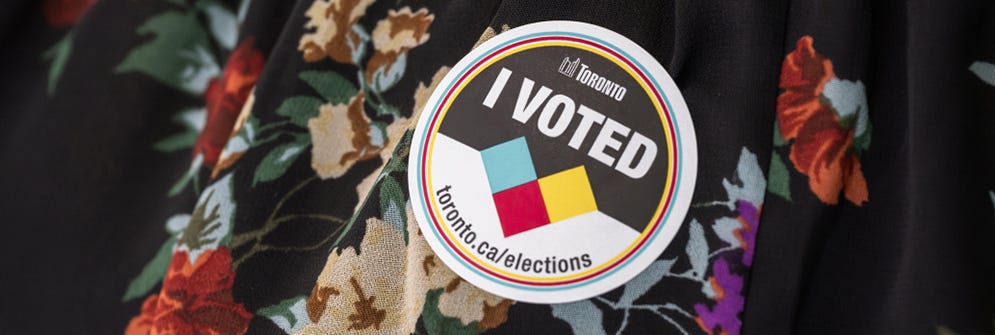
Monday was a disappointing result, and we’ve now had a week to absorb our new reality: four more years of Olivia Chow as mayor of Toronto. Most of us are disappointed and dejected. The three years that have coincided with this mayor would have been unimaginable in 2022, and we can extrapolate what might happen next from there. What might be in store for us?
On the one hand, things seem the worst they’ve ever been for Jews in this country. On the other hand, nothing is ever as bad or as good as it seems. That applies here.
I’m proud of the Jewish community for what it achieved in this election. Regular people heard the call to “get involved”, and for many, for the first time in their lives, they actually answered it.
Many of us have stopped taking our safety and security for granted, and that motivated us to try to make a change at city hall. I’m immensely thankful for and proud of the people that showed up, because it shows we are fighters who won’t take this lying down. But we lost, by 100,000 votes. So we have a long way to go.
We achieved some great things. Volunteers showed up. People were activated. So why, ultimately, did Brad Bradford, the mainstream preferred candidate for Jews in Toronto lose?
There are many explanations, logistics and politics that I described in my article yesterday. But for the Jewish community we can distill it further:
We lost because there aren’t that many of us. We lost because as it turns out, Zionists don’t actually control the world or the media.
We lost because our opponents are way ahead of us.
But most of all, we lost because we are not aligned with ourselves. We are a community that isn’t always rowing in the same direction. And we need to solve that.
Many of us live in cultural bubbles, so it can be easy to miss, but we are a tiny minority in Canada. We are David, an ever-shrinking David, fighting an ever-expanding, hateful Goliath: that of Jew haters, antisemites, and anti-Zionists. The only way to effectively counter something so much bigger than yourself is to be totally united. That’s table stakes. As I wrote in my article yesterday, the progressive left wins in no small part because of its discipline. It wins because it is completely united.
We lost because we are still operating in an older paradigm, one where we could be secure without being united. The world has moved on though, or regressed to its mean, and we have a choice about whether to move on too, or not.
There are two key ideas at play here. The first is unity. We are not united. We are not on the same page. Our organizations are not aligned with each other: synagogues, Jewish charities, Jewish hospitals, Jewish political organizations. They have different goals.
They have different goals because they were set up for different purposes, in times of safety and years of plenty. These are not years of plenty. So we need the leaders of each of these organizations to sit down at a table together and chart a path forward. Maybe that becomes a Toronto Jewish Congress. Maybe it’s a Justice League of Canadian Jewish leaders. The point is though, that everyone needs to get together, decide what the plan is, and execute it, even if the plan isn’t what certain individuals would ideally pick.
I’ll go first and retire my hobby horse.
To demonstrate: I’ve thought for a while that “Jew hate” is not the right term for the modern manifestation of antisemitism. I think “Judeophobia” makes more sense, for lots of reasons. But from now on, I’m giving that one up, at least publicly, because it isn’t helpful to disagree with the broader movement.
Doing that is a highly dissonant practice for me as a Jewish person, because we are trained to disagree, to look for truth, to push the issue and keep asking questions until we are satisfied. We should still do that internally. Of course we should. That’s how we move ever towards truth and justice. Externally though, there cannot be disagreement. It has to be total alignment.
This extends to how we treat our allies and our champions. It means we cannot have people going rogue and bashing those who stand up for us. We need absolute discipline on this. For example: Matt Gurney, a respected Jewish voice, wrote on Substack a couple of days ago about his version of the realities of being Jewish in Toronto. A lot of it was very good. But Matt did something that needs to be retracted and walked back immediately. He took Brad Bradford, the one non-Jewish politician in this city who stood up for Jews, who championed our cause not because it was in his interest but because he genuinely believed in it, and casually floated the idea that Brad Bradford did it out of self-interest. That he wasn’t a good man, wasn’t a man of character, and that in a different universe he’d be on the radical left, just because it’s expedient for him. Matt said all of this on a hunch. That’s disgraceful.
I don’t know Matt, and I don’t want to disparage him, I am sure he is genuine in his belief, I don’t see why he would publish it otherwise. But we can’t publish rhetoric like that anymore, because it undermines everything we stand for. It signals that we won’t reciprocate when someone goes out on a limb for us. Potential allies need to understand that if they put themselves on the line for the Jewish community, they had better be certain that every single person in the community will respect them, say thank you, support them, and never ever throw them under the bus.
Anything less is an outrage. So I’d ask Matt to take it back, to apologize, and to reconsider his words.
We have so few allies that we need to cherish them and reward them for caring about us. Brad Bradford is a true friend and ally. It was extremely disappointing to see Matt’s words as the takeaway for many Jew haters. It’s ammunition for them. It is counter to the unity we require.
Once we have achieved real unity, we have to accept that we are not operating in a political or cultural environment we’re comfortable with or familiar with. I’m referring to strategy and tactics in changing hearts and minds in the court of public opinion. At the end of the day, that’s what politics are about.
Simply put, our opponents are not fighting fair. That’s why Israel’s name is so disparaged, and why Jews are painted as controlling and villainous. The other side is lying. That’s what Dara Horn says in her new book. Antisemitism, Dara says, is fundamentally a lie. I couldn’t agree more. But lies, packaged the right way, seem mighty compelling. For people who get their information from TikTok, Instagram and Reddit, Israel is an evil colonial racist enterprise. Jews are losing the information and propaganda war. We’re barely even fighting the information war. That’s the war we’re in, so it’s the one we need to fight. That means recognizing the verticals through which we’re under attack and matching and competing on them.
The same tactic used to smear Israel is the same tactic used to smear someone like Bradford on his water plan. When you hear the mayor and her allies lie about a plan to privatize water, we know that correcting the record is too little too late these days. The lie has spread long before it can be corrected.
Under no circumstances am I saying we should meet lies with lies but what I am saying is that we have to adopt the tactics that propel those lies: storytelling and, unfortunately, an appeal to people’s qualities that we have tried so hard to avoid: like fear. Sadly, that is what is effective in 2026, and if you don’t do it, you lose.
Those stories need to be compact and have impact. In the attention economy, your messaging has to be as tight as possible. You have to tell your story simply, and think less about facts and more about emotions. It sucks, because most of us have been brought up on sticking to the facts. There is a way to blend both. To tell the truth, do it with honour, but do it in the most compelling way possible while still being tactically effective. This pivot needs to start yesterday.
On the mayor herself, two things can be true. I don’t for the record believe Olivia Chow is an antisemite. I think she doesn’t really care about Jewish struggle much either way. I actually think she is a Zionist. She believes Israel should exist, which makes her a Zionist. Her late husband was a Zionist. I know people in her family now who have admitted they are Zionists. But Olivia Chow is also part of a coalition that is highly disciplined, and that coalition is full of hateful anti-Zionists, antisemites, and Jew haters.
Not all of them of course. But the reality is that to be accepted into that coalition, you cannot zag from the orthodoxy under any circumstances. Because “Israel bad” is part of the orthodoxy, those who might disagree cannot ever publicly state their disagreements. That is their power. It is derived from the unity they demand of their members. Learning from your opponents is competition 101. This is a major competitive advantage of the left, and it can be minimized by being replicated. Discipline is much easier said than done however.
That is the great irony to many progressive movements these days. Progressive organizations paradoxically do not function progressively. They are iron tight about discipline.
Discipline, unity, coherent, consistent messaging. This is what is needed now. Jews and their allies need to be aligned, because that’s what it takes to win now. Jews and their allies need a strategy. To develop and effectively deploy a strategy, they need to centralize the decision making. This is the chief issue. Jews are not a monolith, but politically, we need to start behaving like one. Many of us can infer what those core tenets should be, but the buy-in needs to happen before they are crystallized. That commitment is the key.
These changes will take time to implement, and if and when they are implemented, there will be growing pains as we get everyone on the same page. Some sacred cows will need to be sacrificed. Unity in politics does not mean total agreement. It means being able to stand with the people around the table and being able to live with their decisions and still supporting them even when you disagree. This is a critical flaw in the Jewish psyche, it is exceptionally hard for us to disagree and remain silent.
That will be the test though, can we really unite and speak with one voice?
If Jews want to be successful in politics across the Diaspora, we can no longer afford ourselves the luxury of having two Jews and three opinions. To those outside the community, it needs to be 400,000 Jews, and one opinion.