

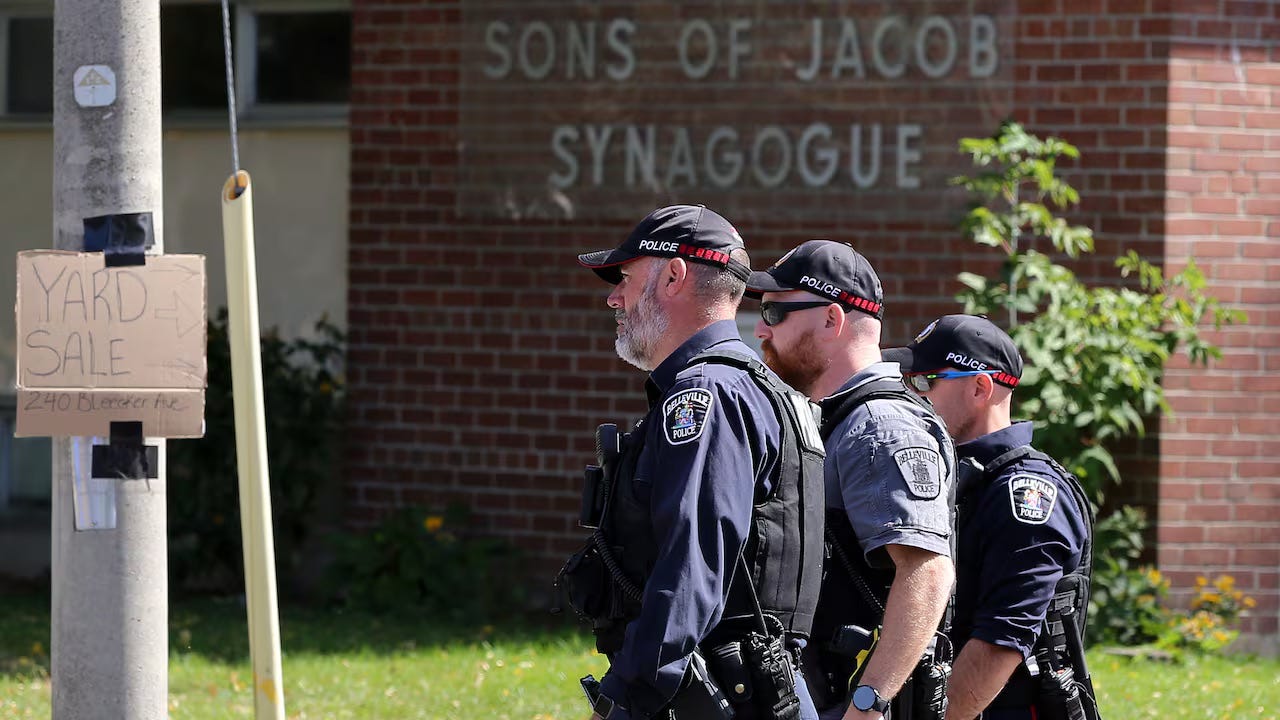
The CBC won’t call it this, but let’s be abundantly clear: on Sunday night, Canada suffered a terror attack.
As congregants gathered at Sons of Jacob synagogue in Belleville for Kol Nidre, the opening of Yom Kippur, the holiest day on the Jewish calendar, a 29-year-old with a shotgun opened fire on the building and the police officer stationed outside. He came, almost certainly, to murder Jews who were strangers to him. The man who stopped him was one of the people this country trusts to protect them: Constable Jeff Smith of the Belleville Police Service, a hero who is in critical but stable condition at the writing of this article. Without him, there would surely have been a much higher casualty rate. And if there’s one thing we can guarantee, it’s that the Jewish community will support and show up for him. A GoFundMe for the officer was started late Monday night, and the campaign has already blown past its goal. Raising money via donations is just the beginning of that support.
Every single Canadian should consider providing that same support. Because make no mistake, while this was a terrorist attack on Jews it was also a terrorist attack on every single Canadian.
Over the course of their history, Jews have often been the canaries in the coal mine of whatever society they happen to live in. Miners used to bring canaries down the shaft because the birds were so much more sensitive to gas leaks. It impacted them first. If the canary stopped singing, you got out, you made a change, because something was wrong. Something systemic. It’s such a salient allegory that last week in Toronto there was an entire conference on antisemitism and Jew hate titled exactly that: A Canary Song.
No one in the Jewish community is surprised by what happened. Our institutions have had to switch their framing, from preventing incidents at all to minimizing the damage when, God forbid, they do happen. It’s why some are spending hundreds of thousands of dollars on security. It’s why there was a police officer parked outside a tiny synagogue in Belleville. “We never would have thought it could happen here” left the Canadian Jewish lexicon decades ago. In the current environment, we assume it will happen here. Two weeks ago, when Jews criticized Toronto’s mayor for not attending the debate on antisemitism, we were laughed at. We were told that we were exaggerating and hyperbolizing the situation for political purposes.
On Monday afternoon, during the calm hours of Yom Kippur, retired Supreme Court Justice Rosalie Abella gave a fireside chat about a lifetime of fighting for human rights. She brought much of the room to tears, but what stays with me is the clarity with which she said this is the most pressing human rights and safety issue in the country. She didn’t dismiss any other group’s concerns. She simply said that antisemitism needs to be at the top of the list for the time being.
Jews have been accused of hyperbole. Of making a mountain out of a molehill. For the last three years I have been asking myself: when will people start taking this seriously? When the hate speech picks up? When someone is killed? I’m not certain anything is going to change after Sunday, and that is exactly how insidious this is. Constable Smith is not in intensive care by chance. This is the logical next step in a highly sophisticated propaganda campaign designed to terrorize Jews.
I think of it as the creep. It starts the way it’s always started, by finding a vertical to “other” Jews on. In 2026, as for the last several years, that vertical is Israel. Anti-Zionism is the ground upon which Jew-haters find purchase. It’s how they sterilize their message and launder it into the mainstream.
Then the message creeps. It creeps into online rhetoric, into protests in Jewish neighbourhoods and outside Jewish businesses, into vandalism at Israeli shoe stores and Jewish-owned bookstores and supermarkets, into harassment, and the line keeps getting pushed, little by little, until someone goes from vandalizing to opening fire. Girls’ schools are shot up. Synagogues are shot at. You get Constable Marc Pinizzotto, killed in the line of duty in Toronto. You get the SPVM’s Officer Mohamed Lamine Benredouane, killed in the Montreal terrorist attack.
The good men and women working in law enforcement probably don’t have much to say about the Middle East. They want to protect Canadians and they put their lives on the line to do so. And now Belleville, of all places, with barely a Jewish presence at all, is the latest in a long string of attacks. It certainly will not be the last because nothing has ever short-circuited the mechanism. Bad actors are only emboldened, because they see no punishment, no accountability, no responsibility for any of it.
It may come out that this shooter was on the right, a neo-Nazi. It may come out he was on the left, so obsessed with Gaza that he felt he had to act. Or he may have been a zealot inspired by religion. Most likely it’s some combination of one of these with serious mental health problems, and a society failing its most vulnerable. He died in hospital Monday night, so we may never fully know. But it was no accident.
Which brings me to Avi Lewis, and what he posted on Sunday night. Robyn Urback has taken this on extensively in the Globe and Mail. I am not saying Avi Lewis is responsible for this attack. But he is, and needs to be, accountable. Our governments need to be held accountable as well. This is not COVID-19, coming out of nowhere and surprising us. The signs have been there for years.
Lewis is implying that Jews worldwide are responsible for an extermination campaign against Palestinians. It’s a lie. He has no actual evidence, and he’s parroting racist and antisemitic talking points, but that’s exactly the point. This movement hides hate in rhetoric, and rhetoric like this is rocket fuel because it’s unfalsifiable, or at least far too complex to be challenged in a tweet. These are Temu social movements, and history shows us they never last. Their authors make a deal with the devil and trade short-term success for long-term annihilation. No anti-Semitic institution has ever lasted as anti-Semitic. It is a poison pill.
Follow the logic Lewis is selling. When you’re taught that an ethnostate is committing genocide, and that all Jews support it in the name of Jews worldwide, then of course you protest these people. When they don’t listen, you take action. You shoot at their institutions and send a message. And when that message only makes Jews celebrate their homeland and dig in for a fight, well, they’ve chosen their fate, haven’t they? Terrorism, murder, violence all become logical conclusions. The logic is technically rational. But the premise is a lie, so every conclusion built on it is false. If we don’t correct the public record on what’s happening in the Middle East, these attacks will continue, and they’ll get worse.
And it isn’t only the Avi Lewises of the country. Anyone who has picked up this rhetoric without knowing their history needs to look inward and recognize that parroting talking points about a foreign conflict causes damage. It is so important to remember that if you aren’t paying for a product on social media, then you are the product. If Canadians don’t stop to soberly consider how we let ourselves be worked into a frenzy of hatred by tweets, TikTok videos, and zero-context images of conflicts, then we are doing ourselves an injustice. We need to acquire the perspective that this is happening, and who is sponsoring it. The shooters in Montreal and Belleville are both dead. The hatred that drove them is alive and well. After Constable Smith and the congregants at Sons of Jacob, there are 40 million more victims this week. We owe it to them to hold ourselves accountable. All Canadians should consider their way of life under imminent threat.
Thoughts and prayers are not enough. That’s the difference between optimism and hope. In one of his Yom Kippur sermons, Rabbi Steve Wernick quoted Jonathan Sacks’s philosophy on the two. Optimism is easy: a belief that requires no effort, a delusion that things will get better eventually. I am guilty of being an optimist. I’m a Toronto Maple Leafs fan, after all. Hope, according to Sacks, is active. It’s believing you can influence the world through work, effort, and stick-to-it-ness. Optimism requires no courage. Hope requires the courage to confront reality, suffering, and tragedy, and then resolve to change them through action.
So is this the moment Canadians channel their hope? Or will we keep being optimists on the sidelines until the next terrorist approaches?