

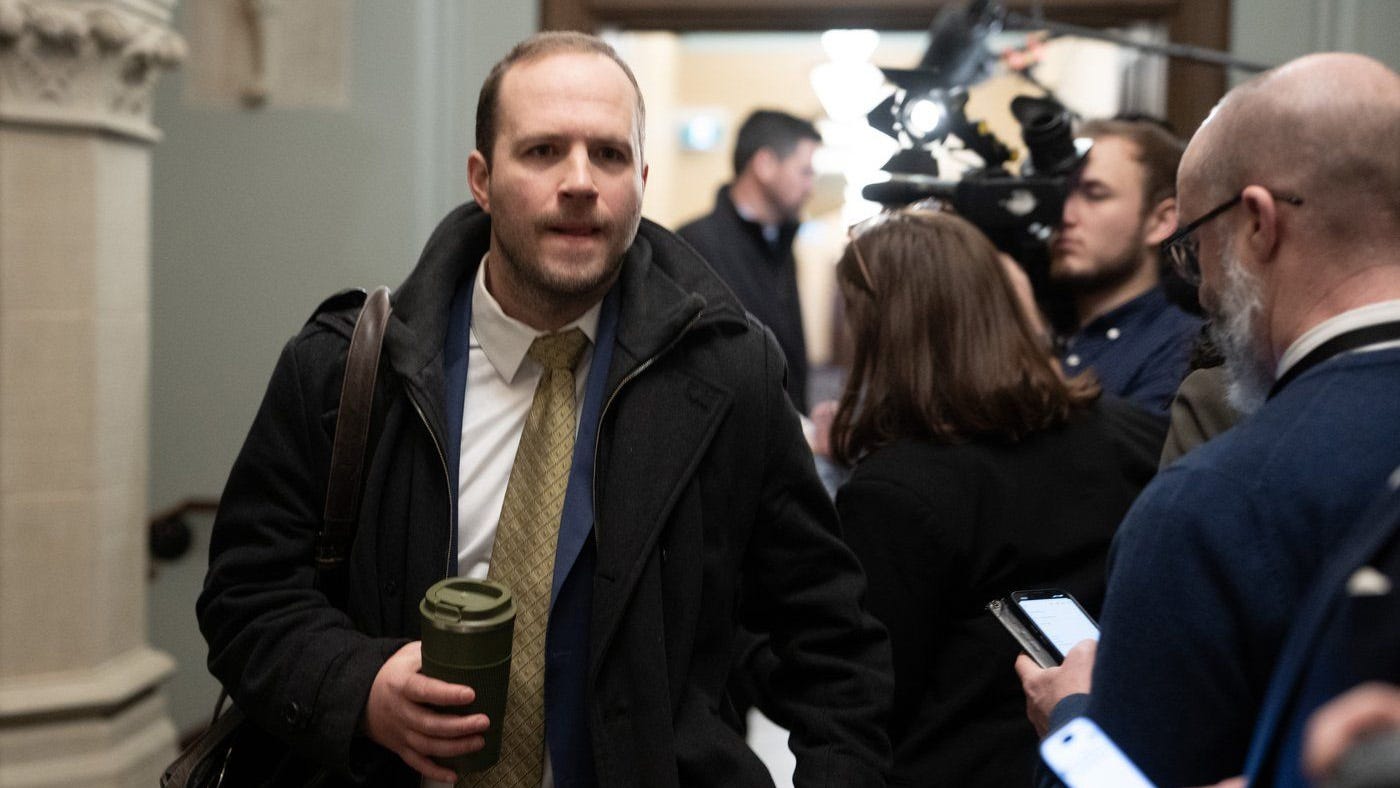
Looking back on his tenure as federal MP, it is reasonable to say that Nate Erskine-Smith was never really a big-L Liberal. Instead he was a Trudeau-era Liberal, and that era is over.
When you look at what he says and stands for, Erskine-Smith has always been a New Democrat wearing a red shirt. He wanted to win and hold office, so he ran for the Liberals during the most progressive Liberal era in Canadian history.
The hyper-progressive wing of the federal Liberal Party is slowly being eradicated, and Nate is another casualty of this purge.
Nate saw the writing on the wall and rightly positioned an exit from federal politics as wanting to make a difference in Ontario. This was a crafty solution that would work well for both him and the party. A diplomatic and sophisticated political move. Everyone gets through the breakup with their dignity intact.
So having been kicked out of cabinet and told he was not the future of the federal Liberals, Nate decided to go forth and announce his backup plan — leading the Ontario Liberal Party. There is a vacuum at the top of the OLP, and Nate assumed that his reputation would carry him to the leadership.
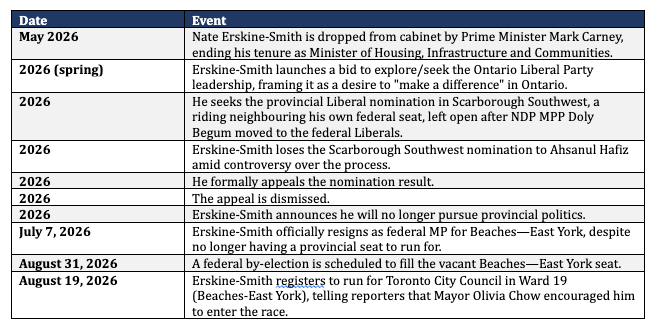
Unfortunately for Nate, that never got off the ground. Erskine-Smith could not even win the provincial Liberal nomination in Scarborough Southwest. This was highly significant — the riding neighbours the one where he was the federal incumbent — and he lost it to Ahsanul Hafiz. There is lots of controversy around this particular nomination, and Nate did appeal the result. His appeal was dismissed though, and instead of maintaining his commitment to helping the people of Ontario, Nate decided that he would no longer pursue life in provincial politics. At the first sign of resistance, he backed off. For whatever reason, Erskine-Smith was not interested in standing up for his beliefs.
Now here is where your spidey senses should be going off, because Nate said he was resigning from his position as federal MP to run in provincial politics.
He didn’t end up going into provincial politics — but he still resigned. Why? Well, the obvious answer was that it wasn’t actually a mutual breakup at all. In actuality, he was dismissed by Carney and the federal Liberals.
Now to his credit, NES has in the past drifted from his party, taking the rare step of voting against the Liberals on many files over the course of his tenure as an MP. As Andrew Coyne points out in his book, The Crisis of Canadian Democracy, dissent is not something prime ministers and federal party leaders abide by. But still, why would someone abdicate a federal position and then a month later decide he wanted to be a city councillor?
My suspicion is that Nate wants to be in charge. He wants power, and when he realized he couldn’t influence the federal party, he sought the provincial Liberal Party leadership nomination. Being premier of Ontario was his backup plan.
When he realized he couldn’t influence the OLP, he went one step further down to his backup backup plan: running for city councillor in Beaches-East York.
Now, I think Nate is doing this because he thinks that the best path to power is to become the mayor of Toronto in 2030. If he sits on council, he will instantly become one of the most likely candidates to come in and be Olivia Chow’s progressive successor. NES’s affiliation has always been fluid — sliding between big-L Liberal and the New Democrats, whether philosophically or in his voting record.
Becoming the mayor makes sense here, he does have a path. Freed from the yoke of Carney and the Liberals, he is joining team Chow and the NDP. This is probably where he’s always belonged, and his next stop will be with the New Democrats — either provincially once Marit Stiles moves on, or in the next federal election under Avi Lewis.
So — the conclusion is simple: Nate Erskine-Smith clearly wants power and isn’t happy settling for less.
Similar to what’s happened with Mike Layton in University-Rosedale, he is elbowing out progressive candidates who have been exclusively committed to municipal politics.
They all deserve mention, but I want to conclude by talking about three of those candidates. Jennie Worden, James Dann, and Natalie Johnson.
Jennie Worden has run in Beaches-East York in the past. She finished second to incumbent councillor turned mayoral candidate Brad Bradford. She was, until yesterday, likely to be endorsed by Progress Toronto. They will now have to abandon Worden and all the work she has done for the progressive left.
James Dann is a city worker with 25 years' experience in parks and planning. He has a lifetime of commitment and a track record of service in Beaches-East York. Like each of these candidates, he has put his life on hold and campaigned to represent the ward municipally.
Natalie Johnson is a reporter with CTV News. Having spent twenty years covering city hall, she understands its machinations and is positioning herself as a common-sense candidate who wants the basics of the city and the ward to work. With Erskine-Smith in the race, she is likely the only one who has a chance to beat him.
I don’t live in the ward, but for me, it would be impossible to support Nate Erskine-Smith at this juncture. He is, in my estimation, parachuting into this race for personal gain.
At the end of the day, the choice will be made by the residents of Beaches-East York. It is up to them if they are comfortable being Nate Erskine-Smith’s “other woman.” Realistically, Beaches-East York — even if he says he loves you — you know deep down, he doesn’t.
Nate will move on when a better opportunity comes up.
The Nate Erskine-Smith timeline
I think you underestimate the intellectual corruption and dishonesty evident in the current administration of the Ontario Liberal Party. By any measure an electoral process that yields more votes than registered voters
cannot credibly be deemed 'fair'.
And I think you also underestimate Carney's shift towards the right. His priority increasingly seems to lie in satisfying the oil and gas industry's desire to increase production and exports, which flies in the face of his supposed commitment to addressing climate change.
I'd accordingly suggest that Mr Erskine-Smith has actually remained committed to his political biases while the world surrounding him has shifted substantially.
How that will ultimately work out in the end, I can't predict. But I think there is something honorable in continuing to serve the same constituents albeit from different seats.