

Preamble
The Ontario Liberal Provincial leadership race is wrapping up. OLP members will be able to vote between November 9 and 20. I am publishing my rankings and how I got there. These rankings are subject to change; I don’t intend to vote myself until close to the end, in case new information reveals itself.
Who I am
I am a millennial CPA and have spent almost my entire life living in Toronto. I have been to over three dozen other Ontario towns and cities. I have 2 young kids and my eldest will enter school next year. I consider myself to be a moderate and have significant issues with Doug Ford. While I am not perfectly informed, I am not a “low information voter” by any stretch of the imagination either – I watched the first and final debates in full, and most of the second debate. I ran (and lost) in a 2026 TDSB trustee election and have volunteered for multiple campaigns, so I have some sense of the demands on the candidates.
How I am thinking about this election and why it matters
This person could very well be the next premier of Ontario. The Ford government has now been in power for over eight years, and on the other side, the NDP’s number of seats has declined in the last three elections. As a millennial, this is a very “high stakes” election. We have seen significant issues in major domains where the province has significant influence, such as healthcare, education and housing. With judicious decisions, improvements on these fronts could be made rapidly, but there is also the risk that proposed “solutions” just make things even worse. It is imperative that we have someone who is evidence based, and is also capable of both working with and standing up to different levels of government. As an example, if the leader cannot demand sane immigration rates from the federal government and proceeds to instantiate rules that promote housing forms that are hostile to kids, housing will not become any more affordable, and on top of that, we will dramatically reduce our children’s quality of life.
First impressions
I have spoken with both Bowman and Fairclough and found them to be decent people who are very reasonable. I have heard Bains speak in person a few years ago – I found him to be quite thoughtful. I have yet to see Marando in person or hear him on the phone, but he also comes across as a perfectly decent person, and a personal connection of mine raved about him.
These general impressions, and the fact that the resumes of all 4 candidates are fairly thorough, led me to give them all a starting score of 8/10. I also appreciated the fact that they have avoided personal attacks, have been quite issues focused, and they all seemed to improve their performances from the first debate to the last.
The Scoring & Rankings
My scoring of the candidates (based on what I consider to be the most important issues) is below. Candidates could go up or down a full point per category, in half point increments. I tended to give more weight to stronger positions, and to written positions over verbal ones.
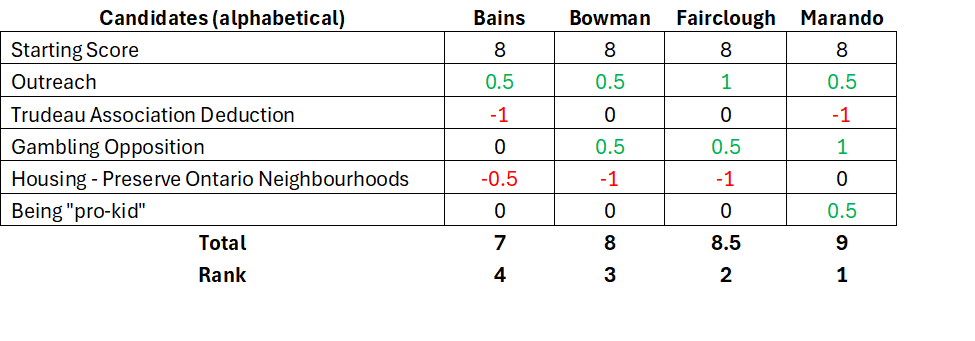
Based on my rankings, my ballot will go Marando, Fairclough, Bowman and Bains. I will explain my scores in more detail below.
Outreach
Outreach matters because for the Ontario Liberal Party to win, it needs to pick up a lot of ridings – Doug Ford has a majority government. Getting to doors is how elections are won, and all of the candidates are clearly working very hard to reach out to voters. They all seem to be travelling extensively based on their social media profiles, earning them all at least 0.5 points. Fairclough takes a full point here though, having been to all 124 ridings.
Trudeau Association Deduction
Ontario Liberal Party members must understand that for many Canadians, particularly those of us who are under 40, an association with the Federal Liberals under Justin Trudeau is a big minus. I am not interested in holding any of the candidates personally accountable for any of Mr. Trudeau’s scandals that rested substantially with either Mr. Trudeau himself and/or the PMO more broadly (Aga Khan, WE, SNC Lavalin, etc.). I can also understand why, for political reasons, when the boss gets in trouble, that being a team player involves downplaying such issues.
However, there were also multiple severe policy issues, and in some cases complete betrayals of the public. Trudeau promised that 2015 would be the last election under first past the post. The federal government then commissioned a survey that was clearly designed to muddy the waters (I know, I answered it), and nothing changed. Trudeau also reversed the OAS eligibility age increase to age 67. Almost all of our peer countries have increased their retirement benefits ages, and I have yet to see any math anywhere that shows that reversing the increase was financially justified. This has benefitted older Canadians at the expense of younger ones. Last, but most significantly, Trudeau’s government crushed younger Canadians on housing. Via immigration, he increased the population way faster than we could ever hope to build for, causing both an affordability crisis and an availability crisis, and then tried to “fix” it with his national housing strategy, which involved spending billions of tax dollars subsidizing demand for home types that aren’t family friendly (condos, stacked townhouses). To put a cherry on top, the Trudeau government routinely resorted to underhanded tactics, like effectively implying that anyone who questioned record levels of immigration was a racist. As a CPA, I have done the math on this: the affordability crisis will take decades to close.
Bowman and Fairclough both emerge unscathed, while Bains and Marando are both docked a full point for their significant involvement in the Trudeau government. Marando has started to give himself “a path to distance himself”, but calling Trudeau “past his best before date” isn’t nearly enough contrition or acknowledgement to reduce his full point deduction.
Gambling opposition
This is an appropriate follow up to the Trudeau Association Deduction; the housing affordability crisis yanked the economic ladder away from Canadians under 40, and then the legalization of online betting effectively put shackles on young people to finish shutting out a generation. Pick a bad social outcome…it is almost certainly associated with the legalization of online gambling. Increased bankruptcies? Yes. Domestic violence? Yes. Suicide? Yes.
Bains has not really said anything, so no points to award here. Fairclough gets her half point for her well documented efforts to at least ban the ads. Marando gets the full point for tabling a full repeal in his written platform. In the final TVO debate, Bowman said she liked Marando’s full ban, and would support it as well – she doesn’t get the full point because it isn’t a written commitment (yet).
Housing – Preserve Ontario Neighbourhoods
During my trustee run, I was involved in a debate that also included city councillor candidates. Pretty much everyone praised the local neighbourhoods. What has gone drastically underdiscussed is how much our historic zoning rules actually contribute to the quality of life we have historically had in Canada. Canada is like “peaceful America” – we have a good amount of space, and we use it; we just have a different healthcare/military spending balance of our tax dollars. The traditional Ontario neighbourhood is overwhelmingly characterized by owner-occupied, detached homes, with yards. The yards means space for Canada Day barbeques, outdoor patio dinners, and for kids to play outside.
Unfortunately, two of our leading candidates, Bowman and Fairclough, have had too much YIMBY non-sense Kool-Aid, and are very pro-“missing” middle. I put the “missing” in quotations, because “middle” forms of housing, in my view, aren’t missing at all, but are instead middling – their benefits are wildly overstated, and their costs are wildly understated. I write this as someone who has lived in condos, a townhome, a semi-detached home, and multiple detached houses. Mass densification is a national catastrophe: yards shrink or vanish, adults and kids lose access to private outdoor space, kids spend less time playing outside and more time playing on tech (which is terrible for their development), tree canopy decreases, the environmental benefits are nominal and debatable (especially given that cars will be electrified in the next couple of decades), families have fewer kids (and we already don’t have nearly enough kids), land value increases erode affordability gains, inequality skyrockets, happiness declines… and I could go on for paragraphs longer.
What is shocking is also the lack of creativity around the issue… “well, if we don’t build up, we’ll have to pave over the Greenbelt”. No you don’t. You keep the Greenbelt, top tier farmland, and critical wetlands protected, and just build on the far side of the Greenbelt. It’s not complicated – Ontario has an abundance of land, and building more roads and rail lines to connect more municipalities provides geographic diversification to our economy.
I am especially devastated by Bowman and Fairclough because they are parents – they should know better. They are expecting the next generation of Ontarians (including their own hypothetical future grandchildren) to grow up in a context where inferior housing forms are normalized. Bowman and Fairclough are both docked a full point for their “middle” housing forms advancement, Bains is docked half a point for not really saying anything, and Marando is left at zero for actually having a housing plan but not advancing middle housing forms.
Being “pro-kid”
As mentioned earlier, we do not have nearly enough children here in Ontario (and all across Canada). We are well short of a replacement rate total fertility rate of 2.1 children per woman; for a range of reasons, while immigration can help address this shortfall in some ways, it is not actually a substitute. From what I can tell, all of the candidates genuinely seem to like kids; Bains, Bowman and Fairclough all seem quite happy that they are parents, and Marando talks about his admiration for his nephews. Marando seems to have the strongest suite – tax cuts for low income families, combined with specific support for fertility treatments. I am tossing him an extra half point. Until we start openly discussing how Ontario doesn’t have enough kids, I am not willing to give anyone a full point, but it’s a start. (Full disclosure: I have a personal investment in a fertility benefits company; however, my investment in the fertility benefits company was motivated in part by the recognition of the significance of the problem, so I am standing by my partial points award.)
My rankings are subject to change.
I do not intend to actually vote until Thursday, November 19th. I want to give candidates as much time as possible to continue to communicate their positions and perhaps update their views. Dylan Marando could admit that it wasn’t just that Trudeau was “past his best before date”, it’s that he also advanced some terrible policies, and he could apologize for his role in that, and could promise to lobby the federal government for sane immigration rates. Bowman and Fairclough could reflect on their own experience as parents, and could come to the conclusion that yes, the Ontario “norm” of single family, detached homes is actually pretty good, and that the “middle” is actually rather middling, rather than missing. Bains could be much more elaborate and specific on his policy direction generally. I could go on.
Here’s hoping a great leader is selected for the Ontario Liberal Party, and that the party continues to refine its policy suite in a good direction between now and the next election.