

“You’re on the bridge to nowhere and you’re getting there fast” - Sam Roberts Band
October 7th shattered an illusion for diaspora Jews. Prior to that day, Jews living in Canada, the United States, Australia, and England felt like they fit in. They were certain that they would be protected based solely on the fact they lived in a Liberal democracy. Antisemitism was barely on anyone’s radar.
Nearly three years later, each of those statements is no longer a given. Many Jews have gone so far as considering an exit strategy if things ever went sideways. That feeling of being assimilated has dissipated. There is now a feeling of threat.
Shockingly, the vast majority of the threat has come from coalitions of the left. In part III of this series, we saw that Jews are granted card holding status from those coalitions so long as they do not hold any problematic ideas vis-à-vis their Judaism or their Jewish values. Yet still, there are many Jews who will suppress those aspects in order to belong.
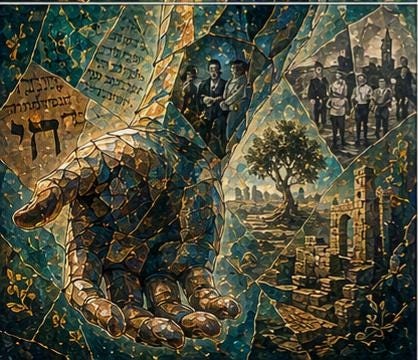
They should know better. Throughout history, Jews have tried to assimilate. Yet time and time again, the lesson is clear: it is practically impossible to complete the process. Attempts at assimilation are like an asymptote - you can never quite get there, at least not in any short term sense. History shows us the reality that it is never left to the Jews as to whether they can truly assimilate.
Leftist coalitions (the primary target of most Jews seeking assimilation) are dominated by rabid adoption of postmodern theory and its world view of intersectionality. There is a paradox in intersectionality, however, that becomes clear after going even a couple of intersections down the chain of marginalization. Jewishness has been declared non-applicable for intersectionality. There is a lack of nuance, every individual person must be either the oppressor or the oppressed. This is based entirely on their immutable characteristics. The result is a binary. In or out.
To be included in coalitions of the progressive left means accepting that you have to make a choice. Therefore, being Jewish cannot be benign. This underscores why defining and classifying the insidiousness of internalized Judeophobia is so vital. Ultimately, Jews can’t opt out of their Jewishness.
So why do Jews join these coalitions? Why do they stick around in them once it becomes clear that Judaism or sympathy for Israeli lives or for Israel is not welcome within them?
There are two primary drivers at play, a push and a pull. The push will be explored later in this series, but can be summarized as a perceived hindrance. There is some aspect of Jewishness holding a person back from achieving their goals. The pull, on the other hand, stems from the most simple of desires – wanting to be liked. The yearning for assimilation begins in something ordinary, the wish to be accepted, well-regarded, safe, and prosperous. That primal human longing to be part of a tribe is the magnet that begins the pull, a subconscious allure to blend into the local context.
In reality though, the promised end goal has always been, aside from the most extreme circumstances, just out of reach. Receiving acceptance from the predominant local demographic becomes akin to chasing the dragon. Each component part that is shed, or swapped out, only feeds the demands for the altar of assimilation.
Assimilation, or the pursuit of assimilation, needs to be defined here. I define it as such: “to give up increasingly large parts or portions of one’s identity in exchange for an adopted identity.” Therefore, to understand the process of assimilation, we need to both define Jewish identity and then define its absence or relinquishment. Identity, of course, is fluid. There is no hard, firm line where you suddenly stop being Jewish. Instead, these attributes are lost slowly, they phase out. It is not a clean break.
This is because everywhere, and in all aspects, identity is fundamentally a gradient. This is the real challenge with this realm of thought - arriving at definitions. We start at the conclusion of identity: we do know that identities exist. We work backwards from there to find our component parts. Jewish identity is particularly elusive. It’s like that Potter Stewart line about pornography: “I know it when I see it.”
To have a proper discussion about anything, you need to define it. Make no mistake, you can define it. Jews, Israel, and Jewish identity are constant battleground topics. Con artists and bad faith actors hide in the nuance. When logically cornered, they will retreat into “you don’t speak for all Jews,” and no progress or conclusions can ever be made. There are also the realities of tokens who say “As a Jew, that’s not how I feel about it.”
Bad faith actors will reference this and posit that Israel is not central to Jewish identity because it is not central to every Jew’s Jewish identity. That carousel of dodging the question needs to be stopped. Yes, we can define Jewish identity. We can do so in the same way we can define any identity. Via the averages of mainstream Jewish behaviour, thought, and opinion. There are two thousand years of Jewish history and millions of Jews living today that can provide valid data points. Those data points form a picture, clusters of trends that can be looked at as a whole.
From those, we start to create identifiable shapes. There is this notion of “Jew” and of “Non-Jew” and the various degrees of assimilation compose the gradient between them. The same way you know when someone is “Queer” (gay, straight, non-binary, etc) or “Italian” (genetically Italian, or raised in Italy). Curiously, this line of thought is rarely, if at all, applied to Israel’s enemies. Bad faith actors are tnever shot down as “not speaking for all Palestinians.”
Of course, you can slice identity forever, but we have to draw the line eventually. As guideposts, we can look at the primary subtypes of Jewish identity in the diaspora to ground the conversation.
In the West, Jewish groups are generally broken down into three categories. Modern Orthodox, practicing, and non-practicing.
The first group, the Modern Orthodox Jews, are clearly not assimilated. They pay taxes, they vote, and they are accountable to the local rule of law. They are legally citizens of whatever country they live in. Their passports say that they belong. The preservation of their culture and habits, however, does set them apart and eliminates them from seriously being considered “assimilated.”
They often live in cultural enclaves for legitimate reasons. The Orthodox dress differently and they observe unique customs. They are instantly recognizable as being different than “normal.” This may seem obvious but it is important to establish this population as a prominent node on the gradient. They are not more “Jewish” than others, but they are more “observant.”
Our second big node is the population that makes up what I will call “practicing” Jews. They are mainly comprised of Jews who come from the Conservative and Reform traditions. They are much further along the gradient to assimilation. This is most demonstrable because they are often not visibly Jewish, and can blend in without trouble in the majority of circumstances.
Conservative and Reform Jews will live predominantly secular lives. They will actively participate in society, and before October 7th, they would have felt like they fit in. That might be the most salient connector - a feeling of unease and danger. Safety aside, these Jews can be grouped together as they subscribe to a set of key values, as well as preferences both named and unnamed that continue to set them apart from the general population. The Jewish relationship with Christmas and Chinese food being a low-stakes yet surprisingly apt example. On the more serious side, key values that are widely adopted include Tzedakah, education, and attachment to and recognition of Israel as the Jewish homeland. These key markers are shared typically (but not always) by the Modern Orthodox populations.
For the Conservative and Reform populations, the summation of identity boils down to being people who, faith aside, are still practicing Judaism in some sense. This clearly eliminates them from being eligible to be fully “assimilated.” In other words, they retain their Jewish identity.
Those pieces of identity can be defined. There is some threshold, 50, 60, 90% of traits, views and behaviours, that make up the polity of Jewishness. Of course, not every Jewish family actually incentivizes their children to go to university, but most do. Jews do not have a monopoly on education as a value, but education is a Jewish value. Not every Jewish person has a Bar Mitzvah, but most do. Many cultures have a coming-of-age ceremony baked in. The nexus of these two begins to build a profile. Once you combine a hundred or more of these traits, you have the identity. Whether or not any individual sees any of these traits as vital or meaningful to their Jewish identity is another matter. How you see these traits is highly influenced by your own bias and sociological interpretation.
For example, keeping kosher is certainly a religious and cultural Jewish practice. But not all Jews keep kosher. Vegans keep kosher. But of course, not all vegans are Jews. This is the crux of the abstract nature of human identity.
The primary point is that when examining any individual within a parent identity, it will be easy to find one of an infinite amount of verticals that would appear to break with what is considered mainstream and “normal” for that parent identity. But the child pieces of identity must be spoken of as valid pieces of the identity because they exist on the whole in terms of averages over large swaths of the parent population. That shared understanding, yes - this thing is part of being Jewish - is ultimately where the definitions have to draw some invisible line that informs the discussion. It doesn’t matter if some small part of a population disagrees with a notion. To speak plainly. If the vast majority of Jews are Zionists, for example, being a Zionist is a Jewish trait. They do. It is.
The counter to this is to use the best sociological method that researchers would provide for proving any identity, that being self-identification. But this is clearly problematic. For example, while “Messianic Jews” (Jews for Jesus) would consider themselves Jewish, the vast majority of Jews do not count them as being part of the Jewish people. They are a tiny minority, and their central tenet is counter to Judaism.
The Messianic Jews show us, therefore, that we cannot simply rely on self-identification. As far as assimilation, Messianic Jews are no longer included as part of the Jewish people, but they are also not assimilated. Many Jews for Jesus would have all the markers of Jewishness, but they are not taken seriously when they speak “as a Jew.”
This all might appear pedantic, but it is vital to the conversation. We can and do draw lines as to what can be considered “Jewish.” There is a precedent here. The flip side of this pedantry is that although you can’t assimilate, you can be something else. A Messianic Jew cannot be accepted into mainstream Judaism, but they also cannot give up all the aspects of their Judaism and assimilate. In other words, they can’t ever not have been Jewish. This comes into play when you understand how Jews (and the offshoots like Messianic Jews) are treated by Judeophobes, including antisemites. They can be wielded as tokens.
This is salient because it provides a wonderful analogue to the third category of Jews - the Jews who no longer self-identify as Jewish in any way. They are the ones who are much closer to reaching the asymptote of assimilation. They may never have been inside a synagogue. They might pray at a church, be completely atheist, and only have one Jewish grandparent. They certainly never had a Bar Mitzvah, or eaten a latke, and they could not utter even a single word in Hebrew. Are they fully assimilated?
The short answer is no. They are closer — but total assimilation is a fool’s errand. As we can see from history, the path through the maze of attempted assimilation always leads to the same destination: ostracization, discrimination, and diminishment. Only through strength, celebration, and positive purpose do Jews ever achieve the safety all humans yearn for. This is the lesson.
Nevertheless, despite the clear futility, many continue to attempt to shed their identity. That mechanism can be expressed as a slow erosion of each component part of the Jewish identity. Those components can be sorted into five primary verticals: religious, cultural, values, politics, and ethnicity. Jews can go down the path, but just like the asymptote in your 12th grade calculus class, they can never quite arrive.
Internalized Judeophobia: Examining The Myth of Assimilation:

“History doesn’t repeat, but it rhymes” - Mark Twain