

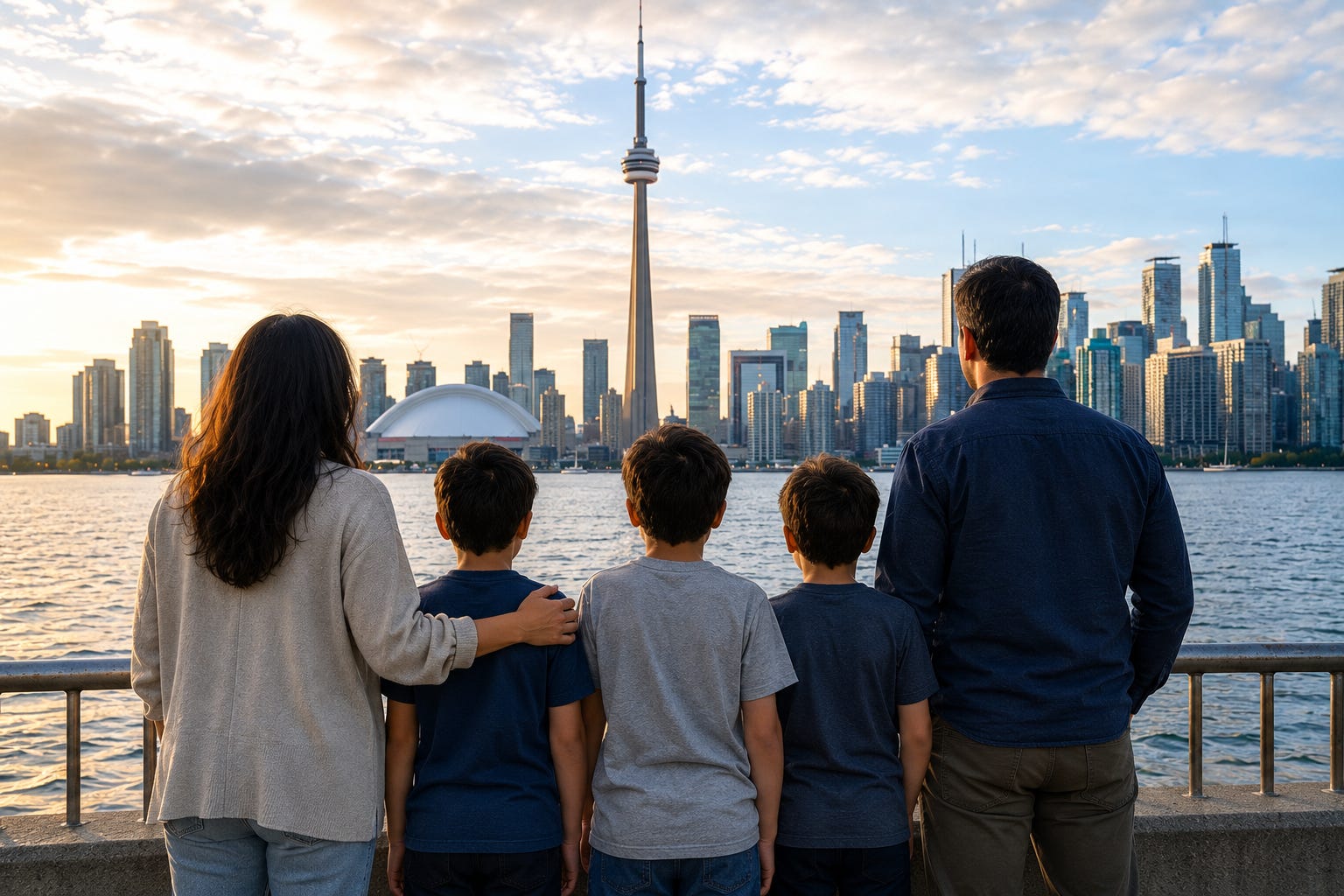
Anna Bronshtein, President of I-CAN (Immigration Collaboration Alliance Network)
October 7th 2023, 6:30 AM and the alarms start to blare.
For Israelis, this is not an uncommon experience. We are used to a certain routine of tension and fear. Usually, you are prepared, the news gives you a warning that tensions are high. You can feel that conflict is coming, so mentally you are ready. You can understand why.
This time, there were no warnings.
We woke up completely confused. My husband and I ran into the shelter with our three young boys, they were still half-asleep, crying, and terrified. As we sat in that suffocating room, we opened our phones to see where the missiles were coming from.
We expect and are hardened to a missile bombardment, but this was not that. This time, it felt like the gates of hell had opened up. Everywhere, all at once.
As the footage started appearing online, I watched a live kidnapping of a colleague’s cousin. The terrorists were live streaming from their phones while they abducted victims into Gaza.
Shortly after, we heard that a coworker’s daughter was killed at Nova.
My employee’s niece was taken hostage.
Another colleague’s young relatives were discovered hiding alone in a closet, their parents gone.
The stories were endless. The tragedy was everywhere. Any sense of normalcy we had had was completely shattered, the life we had built was broken into pieces. We were totally disoriented.
After October 7th, many Israelis fled around the world. Most went to Europe. We chose to come to Canada.
I will never forget our first days in that Toronto Airbnb. We walked into the apartment, and one of my son’s looked around and asked, “Where is the shelter room? Where do we go when the alarms start?”
I told him, “There are no shelters here. Canada is safe.”
He looked at me, trying to process a reality he had never known, and said, “Okay, so if something bad happens, we just go to the staircase like we do in buildings without shelters.”
It took months for my children to adapt to this new way of life, and finally put their guards down. Today, when a loud motorcycle speeds by or a heavy object drops, my heart still freezes in fear. But my kids are unfazed. They have moved past their sense of panic. As a mother, I am deeply grateful for that.
Our children have become Canadian. They have friends and play on their local sports teams. Our family is integrating, we are building connections. For the kids, this is their home.
But there is an agonizing uncertainty lying beneath our quiet lives. A heaviness that is calling into question the sense of normalcy and safety that we feel.
The Israeli community in Canada is highly complex. Some came earlier to escape the political strife that had been gripping Israel before the war. But most of us arrived after October 7th out of fear. To a person uninterested in the legal definition of such things, we could easily be considered refugees. We were afraid for our lives. So packed what little we could carry and fled a dangerous situation to protect our families. Legally though, this is not the case. We are here as what the government calls “economic migrants”.
Professionally, and economically, most of us do not fit the typical immigrant profile.
Data shows that 70% of Israelis living in Canada hold post-secondary academic degrees. Nearly half work in high-tech. Most of us brought significant life savings to sustain our families. Despite our new location, we continue to work remotely for the same companies we did before we left, whether those are in Israel or elsewhere.
We are not a drain on the system; we are actively contributing to the Canadian economy.
Some of us have even bought homes despite the heavy non-resident taxes. Others have started small businesses that are already creating jobs for other Canadians.
We are a diverse group—mostly Jewish, but we have many mixed families, non-Jewish families, and Israeli Arabs. But despite our skills and our deep desire to give back to Canada, we feel entirely invisible to the system.
We are incredibly grateful to Canada and to the Canadian government. They created a special measure; open work permits that allowed us to flee here and find a sense of safety. But an open work permit is temporary. It was a band-aid solution, and next year, the permits will begin to expire.
For those who arrived here on these open permits, Canadian employers were able to hire us with no friction. But now, with the expiries looming, we are faced with a frightening situation. In order to remain here, to continue to build our new lives, those employers must sponsor us through closed work permits or complex LMIA (Labour Market Impact Assessment) processes. Given the difficult administrative burdens, the legal costs, and the hassle of dealing with the immigration authorities, most companies are simply refusing to pursue this option.
As a result, this community of highly skilled, deeply resilient, and profoundly grateful people are being neglected and passed over. While we have proven to be valuable contributors to the Canadian economy, there is no clear path forward to continue building our lives. Because of the technical method of our arrival in Canada, we have no realistic path to Permanent Residency. Our work permits are expiring, and because of recent changes in the thresholds to qualify for those same permits, we have no way to renew them. This means that we are being pushed out.
When we fled a war zone, we thought it would be temporary. But the situation in Israel is not improving. Returning is not a viable option. The war is ongoing. The unpredictability feels just the same as it did when we left after October 7th.
Most importantly, psychological trauma for our families remains our most critical concern. Our children have finally begun to recover. Returning them to an environment where the constant threat of violence is a daily reality would reverse this progress and inflict profound psychological damage.
We cannot go back there. For our children’s sake. For our sake. Yet, as it stands, we cannot stay here.
So we are asking for help. From all Canadians, Jewish, Israeli, or otherwise. We cannot navigate this situation alone.
We do not need charity, but we do need support. We need acknowledgement, professional connections, and advocacy. We need leaders and employers who recognize our value. We need people to understand our legal bottleneck. Most of all we need people who are willing to stand with us to help build a predictable pathway to permanent residency. The exact same way good people stood for your ancestors when they arrived in Canada.
Canada is an amazing country. It is understandable that so many desire to become Canadians. For us, our values align here. We contribute to this wonderful country. We give back.
So if you can, please help. Share this article, tell friends, family, and coworkers about our situation. We need to spread the word, we need unity and assistance in convincing the immigration authorities that we deserve to stay. We are already doing the work at I-CAN, and if you want to, you can learn more at our site: https://i-can.info/
Many other groups have come to Canada via these same open work permits, and have justly been able to become Canadian. Our children deserve the opportunity to live in peace and safety.
We want our families to continue to thrive here.
Please help, because we already call this place home.
Anna Bronshtein is thet President of I-CAN (Immigration Collaboration Alliance Network)

Well done, Anna
Great story! I love it