

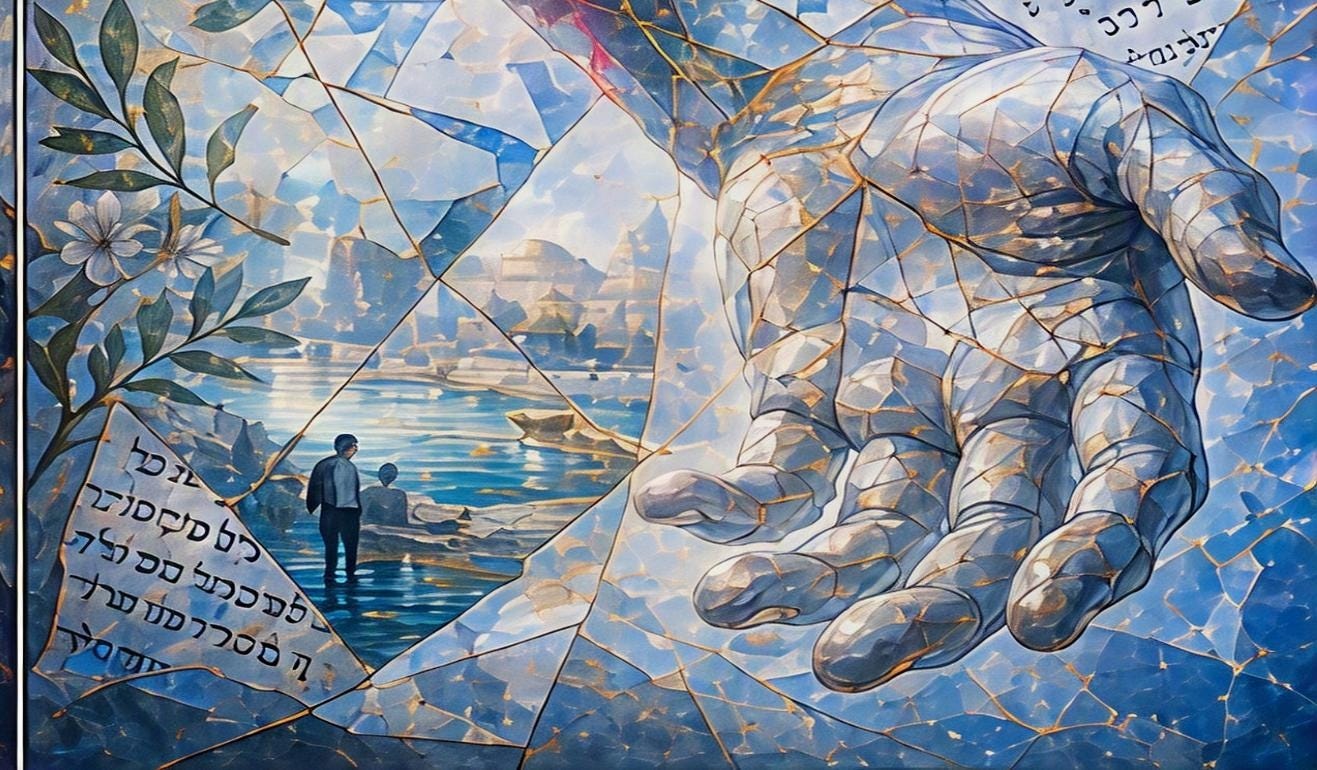
“And if you gaze long into an abyss, the abyss also gazes into you” - Friedrich Nietzsche
In part VIII of this series, we examined some of the most common pushes that act as inciting incidents, priming Jews in the diaspora for the internalization of systemic Judeophobia.

An aversion to Jewish identity driven by a push cannot alone push a Jew to internalize prejudice. In addition to that initial propulsion, there needs to be a landing ground, a target for the mind to set as an imagined harbour for their identity. There is a grander dynamic at play between pushes and pulls, all of which happen within the environment created by systemic Judeophobia. These three forces together are combustible.
In part VIII, we also established that each “push” is motivated by undercurrents of fear, guilt, shame, and insecurity. On the reverse side of this, “pulls” always provide some form of security. There is a perceived safety to allay fears. There is enough distraction to ignore guilt, and there is no external shame. This combines to provide the illusion of security. Optimizing that perceived well being in the short term. This is the trojan horse of the pulls towards Judeophobic identities.
The pulls all tend to be along the asymptote of assimilation, luring identity towards an unreachable goal. Let’s examine the pulls and understand the receiving grounds where Jews who feel ostracized spend their lives.
It is important to note that there is no such thing as a “best” or “supreme” culture, network, or style of living. It is completely natural for Jews to want to participate in all the aspects of life diaspora Jews have available to them. Every culture in the world offers its own wonderful adaptations, new wrinkles, and glorious expressions of human ingenuity, creativity, and thought. Many identities can be moved between freely, at little or no cost — something as mundane as being a fan of an artist or a sport. Those are mutable characteristics. Other parts of identity — core to, and in some way unique to, Jews — can never be fully shed. That is the most salient point, one that cannot simply be abdicated, as we saw in Parts 4, 5, and 6.
There are systems of belief and thinking that do not run contrary to Judaism — dabbling in Buddhism, meditation, and yoga, for example.
There are some value systems, however, that require a cost — a sacrifice or a muting of one’s character and culture. We call this impossible task the asymptote of assimilation.
This is the key difference.
When a Jew moves further along the asymptote of assimilation, they are being pulled out of their identity and into another one. Those newly adopted identities come with varying amounts of Judeophobia baked into their belief system. That is systemic Judeophobia. As parts of this new identity are adopted, they begin to become internalized — even if doing so is illogical or counter to the person’s own well-being.
Humans naturally mimic and go along with social proof. It is a core feature of human socialization. While there are a vast number of potential pulls at play, it is nevertheless worth exploring some of the most common situations:
The illusion of safety in the arms of the left wing.
Many Jews felt like suppressing their Judaism and their tells would eliminate any risk of being unsafe. Most saliently in 2026, we see this pull on the left. This happens in political spaces. This happens in art spaces. This happens in academic spaces.
Within left wing politics, intersectionality and woke ideology seemingly have no room for Jews as a minority group. That means that in the modern iterations of these political belief systems, we have Jews who have been strung along into cults of suicidal empathy that don’t extend to them. For many, this eventually becomes a lifelong version of the sunk cost fallacy: those who find themselves pulled towards ideologies that speak to most of their inclinations and preferences need only sacrifice pride in their Jewish identity. Because they have invested so much of themselves already, they cannot back down or risk losing the “sunk cost.”
The Jewish part of their identity is conditional. It is only allowed on the target group’s terms, in the instances where it is not deemed problematic. If Jewish identity threatens the target identity, it cannot be tolerated. This has the effect of deepening the feedback loop, further conditioning entry into “inclusive” spaces.
The loop “pulls” the Jew further and further away from their identity. If the person is unmoored with no Jewish anchor (typically because of a push) then the abandonment or cheapening of their Jewish self is an easy mental move to make. The arithmetic is myopic and in the short term is a low-cost, high-reward move.
This is the typical outcome for all forms of this phenomenon, and it is why constantly recognizing that assimilation is an asymptote is important. The allure of belonging is intoxicating. It seems so easy to continue down the path you’re already on. You have momentum as you’ve started to integrate and begun to be part of this movement that is brand new and exciting.
Political movements are the most common and significant pull in the modern context because they are so alluring and their long-term costs are hidden. Modern politics in the United States and Canada force you into compartments. They define you along a very slim binary axis. Being pulled towards another identity — say, being a socialist, a leftist, an anti-racist, etc. — all of this pulls you out of your Jewish identity.
We can think of many Jewish politicians, for example, who fall down this path — the allure of power in progressive spaces, the sense of belonging, drive them away from their Jewish identity, from the core of it. It makes them compromise it as they yield to the systemic pressures of their targets, of the orthodoxies of their adopted identity. This can also provide fertile ground for the harvesting of tokens.
The pull into artistic spaces.
This pull, for many, goes hand in hand with politics. Arts workers and musicians tend to lean far left. This means progressive spaces carry a bohemian allure, packed with artists and an ideology that promises equal treatment without the work. Oftentimes, the sunk cost of a lifetime pursuing an art form becomes the only thing that matters.
Consider a person who has spent their life working towards a certain profession or discipline, perhaps an architect or a filmmaker. It is totally reasonable for them to look at the risk and reward equation and make the decision to move down the asymptote. The transaction would be to sacrifice decades of toil, social networks, and professional clout in order to — what? Pay homage to a religion they don’t even believe in? They are missing the full picture, but in each small moment, their choice seems clear, as well as completely reasonable and appealing.
The pull into professional spaces.
Conforming to an in-group culture is endemic to human psychology. In some professions there is a reinforcing cycle of opinion and ideology. There are orthodoxies and sets of interlocking opinions that seem inexorably linked. Stapling on Judeophobic tropes, especially around Israel, is frictionless.
Consider the arts-worker orthodoxy, the social-worker orthodoxy, the healthcare-worker and addiction-specialist orthodoxies. Even labour unions, at times, are run by severely Judeophobic people. Each of these has a massive bias and overrepresentation of specific ideologies. It is sensible to sacrifice your own identity in order to be respected in the workplace. For many, the workplace is the only community that they have. If there is a dominant ideology, set of values, or way of thinking about the world, it is only natural to absorb it. These newly adopted professional identities can certainly pull a person away from their Jewish identity.
The academy
Higher education and school systems writ large are currently facing something of a reckoning around their adoption of postmodern thought. In the era of diversity, equity, and inclusion, entire departments are purged of people with politics right-of-centre — or really, anyone who would dissent from progressivism. There is a strict dogma in most humanities departments. Non-political subjects like physics and biology are en route to being captured as well. Taking on the identity of your workplace, and that of an academic who needs to be focused on progressivism and activism, is an immensely attractive pull. There is professional clout at stake, tenure, security, and the allure of acceptance. Universities and colleges are incredibly strong and vast community networks.
So, a Jewish person becomes unmoored from their personal identity and then is pulled towards other identities along the asymptote. There is a mountain of work done on the groupthink that encompasses universities. In Canada, there is the CASE report that outlines, among other horrors, a trend of active antisemitism coming from professors. This is never punished — if anything, it is rewarded.
For students, these pulls are just as present. What’s more, they are formative. Students are vulnerable, they are at university to learn. For most young people in the West, post-secondary education is the time that they are allowed to finally self-actualize. When student groups, clubs, residency associations, and professors’ philosophies are all geared towards a certain ideology, the plasticity of the student mind can quickly internalize Judeophobic tropes, ideas, and thoughts with almost no resistance.
Friend groups.
On the micro scale, this idea translates to peer groups just as much. Social proof is a powerful tool. Many Jews will choose friend groups that are predominantly non-Jewish, and they will not understand or recognize the slights and slings and arrows that are levied upon them.
This opens the door to antisemitic or discriminatory tropes — systemic Judeophobia spread, consciously or not, by their peers. Comments like “Jews are cheap” or “have big noses” eventually get glossed over.
Of course, any kind of discrimination is waved off. Their peers, colleagues, and interlocutors are not prejudiced or racist people. They are predominantly just naive, living in a context of systemic Judeophobia where they have no reason to investigate further into claims about Jews, Jewish people, and the Jewish state. Again, the calculus becomes clear: do you stay silent and accept the claims, or do you risk your personal standing in your community?
Again, this all makes sense because there’s so much good done by all of these movements. The kaleidoscope of activities, ideas, spaces, and movements in the West is incredibly appealing — it’s a prime reason Jews have been able to survive and excel in all these different capacities. Other identities are wonderful, but sometimes they come into conflict with the Jewish identity, and that can be another point at which a decision is forced.
If the Jewish story is not told and the heritage and culture are not held in high esteem, the exchange is often made willingly without the true value of the identity being understood.
This is like a subconscious mental negotiation wherein the Jewish part’s value is completely undervalued. The Judeophobic pull is a Trojan Horse.
More miscellaneous examples.
Like the pushes away from Jewish identity, there are too many examples and circumstances of Jews in the diaspora being pulled into other identities. A few more include:
A person marries into a family that holds antisemitic views.
They ultimately have a decision to make: forgo their family, their in-laws, who may feel extremely passionately about certain issues, Jewish values, or the Jewish state, or risk their relationship — and their children’s relationship — with the in-laws, and acquiesce instead.
The Country Club Member.
In the 20th century this was a much more common occurrence. But as Judeophobia began to morph into anti-Zionism and Jew Hate, it has become less common. For now, Jews are not categorically denied entry into elite society.
Sometimes at the heights of society there are carrots and opportunities too irresistible. Oftentimes, these positions require a sacrifice. This is a less common situation in modern times, but this idea coloured Jewish assimilation throughout history in the West.
For many whose Jewish identity was not a significant part of their life, the pull toward these prestigious institutions was strong, and they happily sacrificed any signs or symbols of their heritage for access. It did not matter that these places clearly were not hospitable to Jews.
In the early days of the reform movement, this was its stated goal. In an enlightened world, Jews wanted to be treated just like everybody else. The degree varies, but the pull of assimilation always seduces unknowing or naive Jews. The siren call is always there.
Romance.
There are young people who are more interested in pursuing romantic partnerships than in exploring their own identity. Each of these is reasonable. And the shortcoming is when they make the exchange and sacrifice something immeasurably valuable — thousands of years of heritage — for something ephemeral.
The consequences of each of these pulls, especially when paired with the pushes, are that they operate as access points for systemic Judeophobia to become internalized. When other worldviews have accepted or incorporated antisemitism, Jew Hate, stereotypes about Jews, then it can easily sink in and access your subconscious.
Anarchy.
The energy of anti-establishment protests is intoxicating. In a world where everyone is struggling to belong, belonging to something else, despite some concessions, is arithmetic that can be relatively easily rationalized.
The umbrella idea is that this exchange, the pull, is done subconsciously. People build their entire lives, not recognizing that this is what is happening to them. It can take literally decades before these micro-Judeophobic messages are amalgamated into internalized Judeophobia.
In the next part of this series, we will put it all together and examine circumstances that demonstrate the explosive nature of how pushes, pulls, and systemic Judeophobia combust into full-on internalized Judeophobia.
Internalized Judeophobia - Combustion: How Self-Hatred Manifests

“Every time I say ‘I’m Jewish,’ it feels like I’m confessing to a crime” - anonymous reddit user