

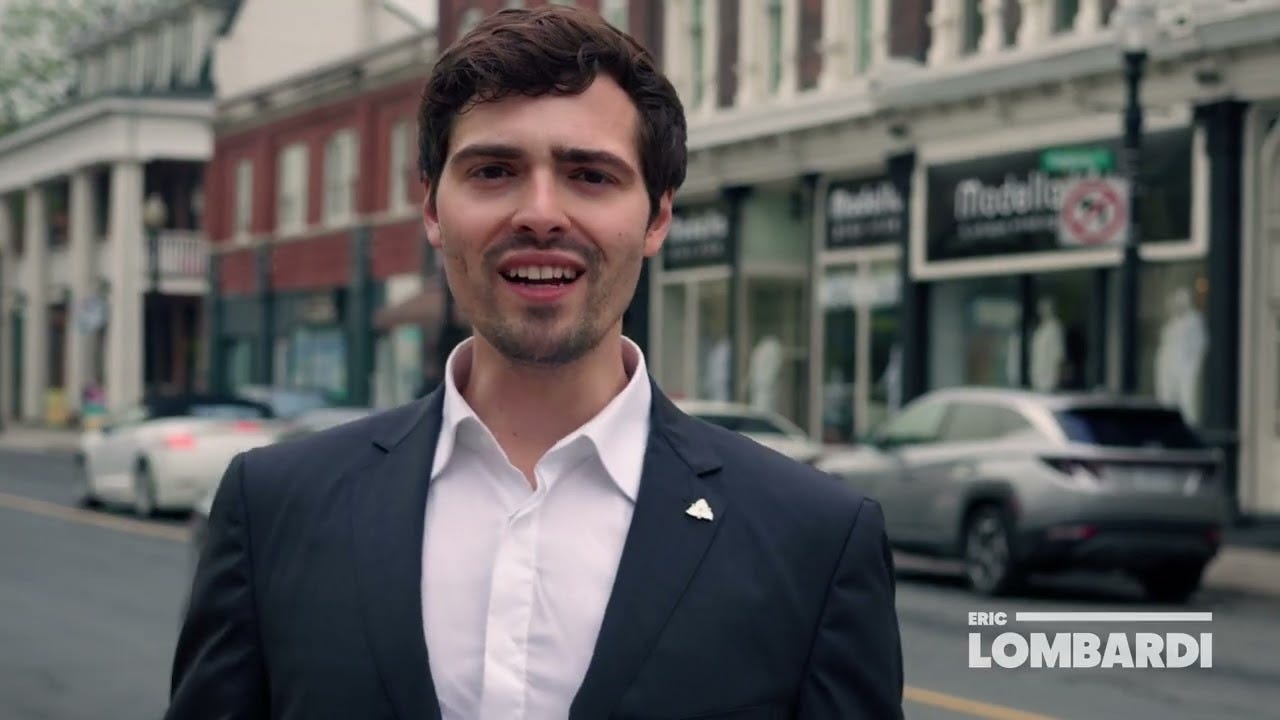
After the longest Ontario winter in living memory, with a news cycle being dominated by Iran, the Knicks, and the FIFA World Cup, something remarkable happened on Canadian Twitter this weekend.
Sleepy old provincial politics are popping up on Ontarians’ newsfeeds in a way no one could have predicted. Newly declared candidate Eric Lombardi is making a splash.
Eric announced his candidacy for leader of the Ontario Liberal party last week and people are paying attention. His campaign announcement video is on its way to racking up half a million views. He raised $100,000 in the first two days, has drawn the ire of some establishment Liberals, and is actively engaging on real policy matters with the electorate online. Twitter is its own ecosystem, but could we be witnessing the beginnings of the next real political player in Canada.
History doesn’t repeat itself, but it does rhyme and Lombardi could echo the rise to prominence of another provincial Liberal titan, Dalton McGuinty.
So who is Eric Lombardi?
Eric is self-described as “a finance and technology entrepreneur turned civic builder, and a leading voice on housing reform, institutional renewal, and economic opportunity for Ontario’s next generation”. Those who have been following him see him as a pragmatic policy wonk who wants to put the “classical liberal” back into the Ontario Liberals.
He says he believes in:
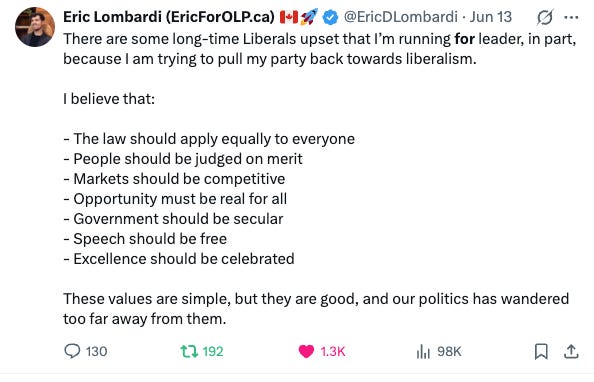
Now none of these declarations jump out - they aren’t exactly “man the barricades” rhetoric. But that’s where the comparison to McGuinty becomes apt.
Lombardi echoes McGuinty by being the 2026 version of a dependable, trustworthy person who actually seems to know what he’s talking about. He is not interested in hot takes, not prone to insulting his political opponents. He is calm and pragmatic.
But to understand the potential for Lombardi moving forward, we need to look back to how Ontario arrived at this moment, and why Lombardi might be primed to take the OLP back into relevance.
A Birds Eye View of the Last 25 years:
Before McGuinty started leading the Ontario Liberal Party in 1996, they had only won one election in 50 years. At 41, he was able to win the leadership by convincing delegates that he was the best person to fight the Progressive Conservatives on economics and ideas. As leader, he won three elections, and resigned in 2012.
He was succeeded by Kathleen Wynne who carried on as Premier and won another majority in 2014. Eventually however, incumbency caught up to the provincial Liberals. Scandals and a desire for change shifted the mood of the electorate; Doug Ford’s Progressive Conservatives won a landslide in 2018, and have been cruising ever since.
Ford is almost a decade into his premiership and hasn’t had to face any legitimate challengers. He has oscillated on policy, and scored many own goals. Issues like the green belt, the Science Centre, and most recently the private jet have gone on without any real punishment. Try as they might, NDP leaders Andrea Horwath and now Marit Stiles just haven’t been able to capitalize on the slipups.
Ford’s government has existed in a federal context that is important to examine: The Justin Trudeau era was defined by a progressive shift for the federal Liberals. Trudeau capitalized on a desire for sunny ways ahead: He tapped into a national appetite to do good, which manifested in identity politics and for the human yearning for change.
Then 2020 hit. The COVID years granted federal and provincial governments permission to run massive deficits in the name of emergency. Both Doug Ford and Justin Trudeau opted for government handouts.
After nearly a decade of Trudeau, many Canadians began feeling the pain of lockdowns and tougher economic times. The left pivot inspired a tougher, more pragmatic leader in Pierre Poilievre on the right. Poilievre’s constant attacks and appeal to common sense resonated with voters who were worried the government was getting carried away. The cracks were beginning to show. Before Trudeau resigned, Poilievre was a lock to be the next prime minister.
Then the federal Liberals had a stroke of genius and pivoted to Mark Carney. They saw what appealed about Poilievre, borrowed it, and made it better — without any of the baggage. No COVID-era trauma, and Carney just seems like a much nicer guy than Poilievre demonstrates himself to be in the media.
A miraculous comeback ensued, and a few months later, Carney was PM. Carney’s greatest strength is that he evokes a feeling of trust; he is seen as intelligent. Like he actually knows what’s going on. This is incredibly popular with Canadians. Perhaps most impressively, Carney’s aura has been able to carry the party through a year of record deficits, a “technical” recession, and more promises than actual action. This hits precisely on the zeitgeist: Canadians’ desire for calm, pragmatic leadership.
So What’s at Stake:
With that context in mind, we can return to the provincial Liberal leadership race and Eric Lombardi. What Carney says he stands for is ostensibly what Eric Lombardi says he wants the Provincial Liberals to stand for. The key difference is, that if this is the direction for the OLP, there won’t be the same baggage holding the provincial Liberals down. The feds are composed of an established coalition and infrastructure. That comes with competing needs, old promises that need to be fulfilled, and a decade of warts.
Given the clear appetite among Canadians to get back to pragmatism. We can see why Lombardi is so intriguing to so many. People have been calling for a return to meat and potatoes politics for a long time. That audience is finally being served.
The highest profile Liberal candidates (declared or assumed) for leader thus far have been Trudeau-era federal holdovers who seem to think they can fall upward into provincial politics. Navdeep Bains and Nate Erskine-Smith are relics of an era the electorate has seemingly already moved on from. It was telling that Erskine-Smith couldn’t win the recent nomination in Scarborough-Southwest.
Lombardi, on the other hand, offers an alternative that sounds pretty good to the common sense voter who wants change at Queen’s Park.
We’ll see how Lombardi tracks with voters. But in sleepy provincial politics, where voter turnouts are microscopic on a good day, a little momentum could translate into a massive edge.
Can Lombardi channel the early days of Dalton McGuinty and be the pragmatic, thinking Ontarian’s candidate?
Early responses to his candidacy seem to indicate his message is resonating, especially with younger voters who are feeling the pinch of the affordability and housing crisis.
But what is most remarkable, is that anyone is talking about this nomination at all.
We’ll have to see what’s next.
.
His principles and his party’s principles are antithetical.
He will conform to its principles and vote accordingly, or leave the party, or be buried. There is no fourth option.