

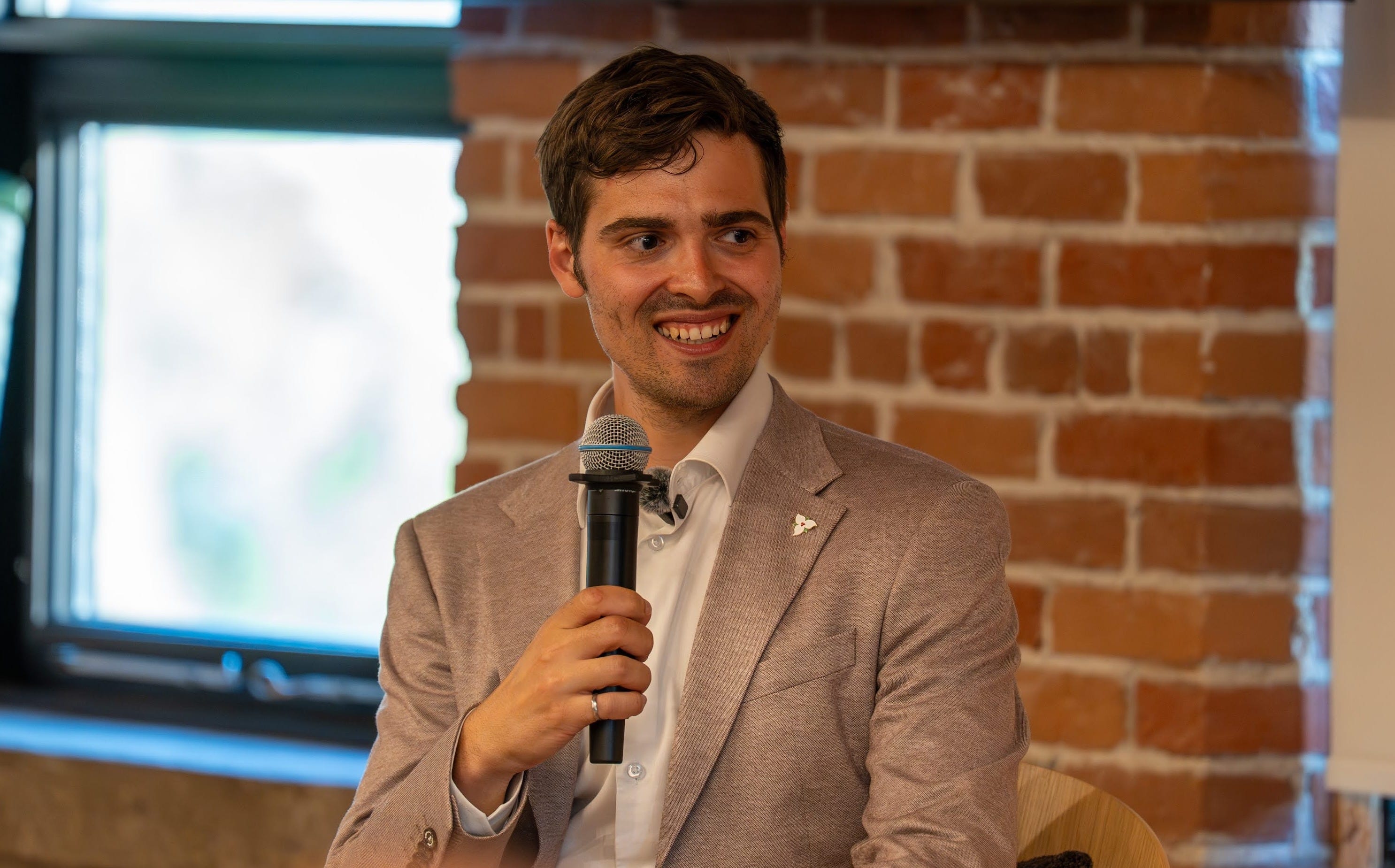
Tuesday evening, at the offices of Toronto tech startup Ada, Ontario Liberal party leader hopeful Eric Lombardi gave a presentation on the future of Artificial Intelligence titled: “Should we fear an AI future?” The Liberal leadership election is in full swing, and Lombardi chose to tackle one of the most hot button issues facing Canadians.
What stood out most about that room was that the audience was made up almost entirely of people under the age of forty. For provincial politics, that is an incredible feat. It’s particularly salient because it shows genuine energy behind Lombardi’s campaign.
Millennials and Gen Zs have grown up in an era where politicians tend to have a lot more in common with their parents than with them. Voter turnout has always been lower in younger demographics, but the worm turns, eventually.
This is the fundamental energy behind Zohran Mamdani in New York, and is perhaps a contributing factor in the emergence of a candidate like Brad Bradford in Toronto.
When someone born after 1985 can finally see themselves in a candidate, politics can reposition from something observed to something participated in. For a Canadian electorate whose politics consumption is primarily American, it’s no wonder that they feel that Canadian politics are out of reach. The United States is the jurisdiction that they know the most about, and they literally can’t vote there.
While their policies and auras couldn’t be further apart; Mamdani, Bradford, and perhaps now Lombardi offer an elimination of that barrier. Making politics accessible and tangible.
The Ontario Liberals, for their part, have been disorganized, divided, and rudderless since the Wynne era. Having that youthful energy as the centrepiece to build around is something that has been long lost in provincial politics. So perhaps the lane is open for OLP strategists and voters to take a good hard look at this candidate.
One of the greatest challenges for aspiring politicians is showing credibility and expertise on the issues of the day. This is especially so with a younger candidate like Lombardi. On the matter of artificial intelligence, expertise evolves month to month. Lombardi studied engineering at the University of Waterloo and spent time working in Silicon Valley — he walked the walk, as it were, and the tech workers in the crowd were there to validate that.
Lombardi went at this issue with a thesis: the province is at a crossroads when it comes to AI. Technology evolves, and is only becoming more integrated into our lives. The choice, therefore, is how to approach that future: will Ontario happen to AI, or will AI happen to Ontario? Will we make decisions that lead to a world where technology serves humans, or where humans serve technology? In other words — should we fear an AI future?
The discussion was framed as a choice to be positive and ambitious about the province. Lombardi made the observation that dominant narratives around AI change according to whatever most incentivizes the AI companies and their leaders. When seed funding was required, AI execs were ringing the alarm bells of AI as a disruptive technology that would destroy jobs. Fear of missing out on a revolutionary idea also drove the feeling of scarcity. Today that framing persists in North American sentiment towards AI. Now that it is no longer financially or politically prudent for AI to be positioned that way, the Sam Altmans and Elon Musks of the world have changed their tune. It’s a pattern that Lombardi relates to other high-tech trends like those seen in Crypto and NFTs.
The ability to demonstrate nuance and think deeply is a feature of Lombardi’s campaign. He has plans and principles, but he also does not pretend to have all the answers. During the Q&A, when met with complex questions such as how to prevent the brain drain in tech — the 60% of his Waterloo classmates who no longer live in the province —Lombardi’s response was direct: “I don’t think anyone can really know the answer to that question.” Instead, he was pragmatic about solutions. He is seemingly unafraid to say: “I have to think about that” His answers and ideas tend to be geared towards the long-term, and they usually concern foundations. To Lombardi, the way forward for the province is exactly that: a focus on foundations. Doing the boring, deep work, with policy as the tool to reshape incentive structures, and ultimately, behaviour. In a room full of software engineers, product managers, and company builders — the kind of people who often live by a mantra of “move fast and break things” — that was an interesting dichotomy. Lombardi is suggesting we create the conditions for those builders and their risk appetites to be able to push Canada into the next generation. In sum, he does not think we should fear an AI future.
Therein lies perhaps the greatest opportunity for the OLP. Tech workers specifically have a reputation of being the kind of people who will manage a product, hop on a sales call, rock climb, and sing in a choir, all in one day. In Canada, they don’t seem to be captured by any specific political party. So if the provincial Liberals can harness that kind of persona they suddenly have some valuable skills in their arsenal: creativity, talent, and capacity are a powerful mix. While it is the same field, Ontarian tech workers are not cut from the same cloth at the Silicon Valley tech bros; they tend to be Torontonians who are just as interested in their hobbies as they are making money.
For an underdog like Lombardi, it makes a lot of sense to engage with these builders and with the young people that flock to these companies. Today’s youth are oftentimes painted as screen-addicted, isolated, and lazy. But the truth is, they are talented, informed, and deeply passionate about equality and living in a society that works for all. The problem is, historically, young people just don’t vote. Building a movement that works for them, and addresses the concerns of their parents, might just be the winning path.
The biggest fear of the young is being locked out of potential economic prosperity. That capitalism will move into a frozen state that promotes wealth inequality and prevents class mobility. That scenario can be referred to as neo-feudalism - where, like medieval populations, inherited wealth matters far more than merit, and only those whose parents own homes will in turn own homes themselves.
Identifying that bad AI future and using policy to avoid it is Lombardi’s message. Restoring attention to the fundamentals. Eating the political vegetables that allowed western society to thrive. It remains to be seen if this message will resonate with the kids.
Rudderless and leaderless as the OLP is, they still poll well amongst Ontarians. The next head of the party has a legitimate shot at being Premier. In the last leadership race, Bonnie Crombie became leader with only 11,000 votes. So momentum based on a young energetic and motivated segment of the population just might be the winning way going forward.
You can watch and listen to Eric’s full talk here:
