

The FIFA World Cup is going to 64 teams. UEFA revolutions aside, the expansion is inevitable at this point. Assuming that ship has sailed, we can focus on what the expansion to 48 brought, and hope to avoid repeating those same mistakes. With a diluted field, the first round of the World Cup in 2026, the group stages, was essentially meaningless. This is the most glaring issue, and it only gets worse with an expansion. Just under three quarters of the games were low stakes.
So, with the impending further expansion, FIFA needs a format that could fix some of the most common concerns. Not one that exacerbates them.
That starts with addressing the low stakes nature of the group stage. While many attribute the blunting of tension to the existence of third-place finishers (more on that below), the true root cause was the drastic delta of quality between groupmates. Revisiting the schedule, only a handful of the games were contested between top sides. There were Morocco-Brazil, France-Norway, and perhaps England-Croatia. With twelve groups, there are simply not enough good teams to make it all interesting.
With that delta, the format saw an unprecedented rise in blowouts. Canada crushed Qatar, Germany beat up on Curaçao. There were 18 group stage games decided by three or more goals. There were only 5 in 2022, and 8 in 2018. FIFA loves to flaunt Cabo Verde as a success, but they were the exception, not the rule. With more blowouts set as the expectation, many more of these games become uninteresting. Many fans will set their alarms for the round of 32. We can only imagine the carnage for minnows in an even further expanded field.
Speaking of minnows, the expanded format missed the mark on qualification. The confederations’ allocations were clearly mismanaged. Most of all, it was unfair to Europe. 6 of the 8 quarterfinalists were European, which is a clear indicator that they deserve more slots (if you weren’t already convinced). Federations like Denmark and Italy missed out, while Jordan, Curaçao, and New Zealand all made it in. There are flaws in UEFA’s formatting which I spoke about here. This injustice can be remedied by allocating an outsized percentage of the 16 new slots to Europe.
A further problem with the qualification format is that for some teams, luck of the draw made the fixtures academic. A team like Morocco’s toughest competition was the country of Niger (not Nigeria). New Zealand had to fend off mighty New Caledonia. This means that for a lot of teams, qualification becomes a snooze. Those are the games where tough competition might improve federations. Pressure makes diamonds, after all. An expanded format with rejigged allocations can fix this issue.
To dwell further for a moment on those low-ranking teams, don’t they want more than just being there? While qualifying for the World Cup is an accomplishment, and should be celebrated, one might suspect that having competitive matches would be better for everyone involved. But for the minnows that are Jordan, Uzbekistan, and Iraq (pay no attention to the AFC trend), it must have been a bit like eating something that’s past its best-before date.
This is a separate argument to that of qualification, but it is all related. Those minnows getting blown out have the extra effect of compromising the fairness as it pertains to the third-place finishers. I.e., Sweden had the good fortune of playing against Tunisia, and that disparity essentially cost a country like South Korea a third-place qualification for the next round and a chance to go on a run.
More importantly perhaps, this made the tournament extremely hard to follow. The randomness of the third-place teams, the ambiguity of who might play who, the fact that some first-place finishers got to play against third-place teams but not others, it was all a mess. For fully invested fans, there were simply too many permutations to follow along, and that made a lot of games irrelevant to watch. It was even problematic for gamblers, as predictions became too hard to make with the bracket so ambiguous.
Each of these issues share the same core problem: the format of the tournament. I contend that FIFA has an opportunity to solve all of these issues when they invariably go to 64 teams. It just requires a bit of creative thinking, and perhaps most problematically, that not all World Cup qualifiers ought to be treated equally.
The solution I’m proposing with the 64-team tournament is to split the World Cup into two divisions — 32 teams in an A division and 32 teams in a B division. The As consist of roughly the top 32 qualifiers, and the Bs, the rest of the field. This format is inspired by precedent. It pulls from the logic of the page playoff system, wherein the first-place team plays the second-place team, and the winner of that goes to the final.
It also borrows from Olympic women’s hockey, wherein all of the favourites were in a division where they were playing for seeding, and then the teams that were clearly second-best in a different tier — like Italy, the hosts — got to play against teams that they might have a chance to win against. Ultimately, this makes the games more competitive, more compelling, and it still leaves every team with a chance to go on a run and win the whole thing.
Qualification can remain up to the individual federations, but the best-performing teams in qualification will be placed in the A division. That top 32 is a rough simulacrum of the World Cup prior to 2026 — 32 teams with approximately the same confederation allocation.
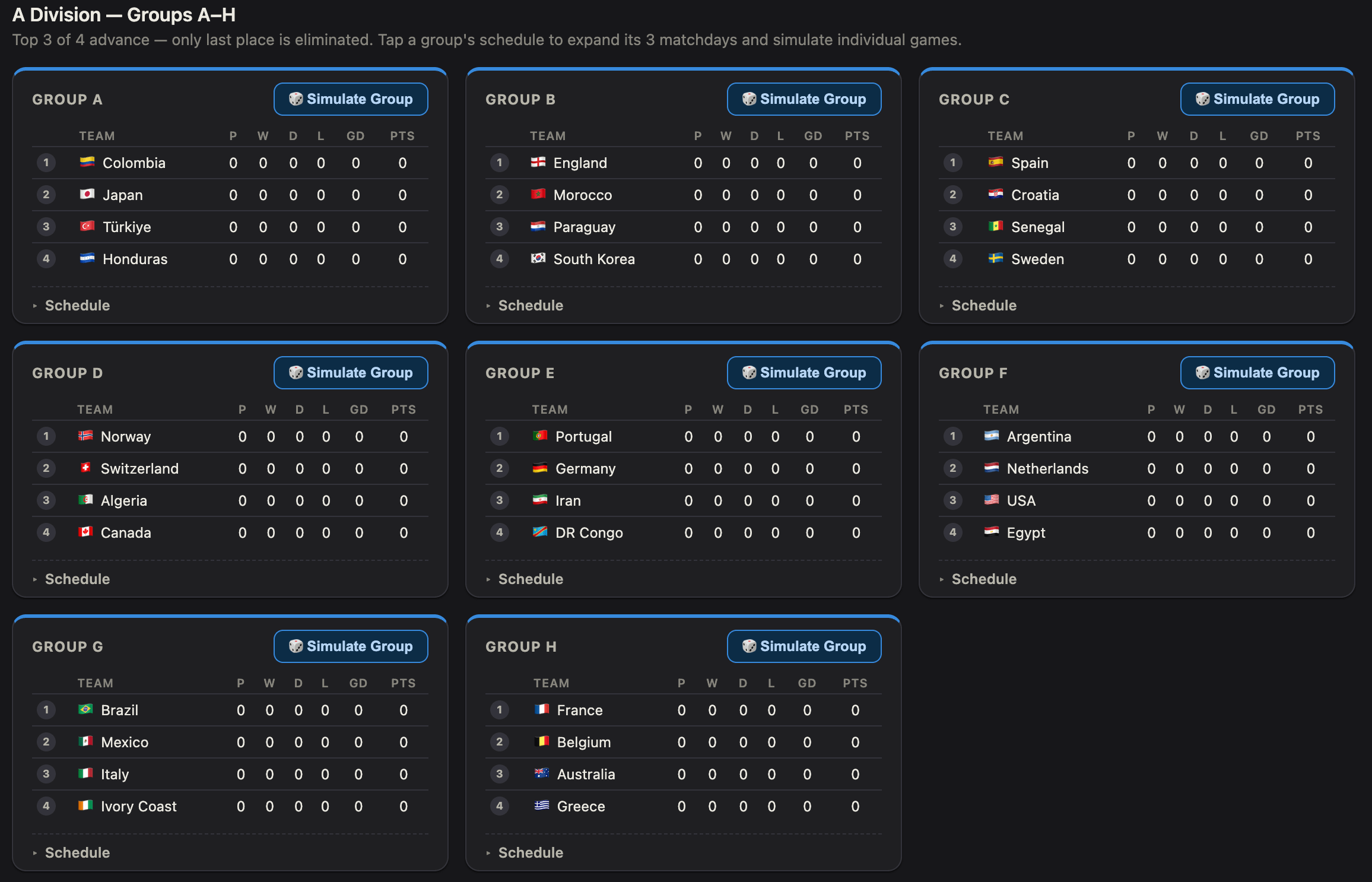
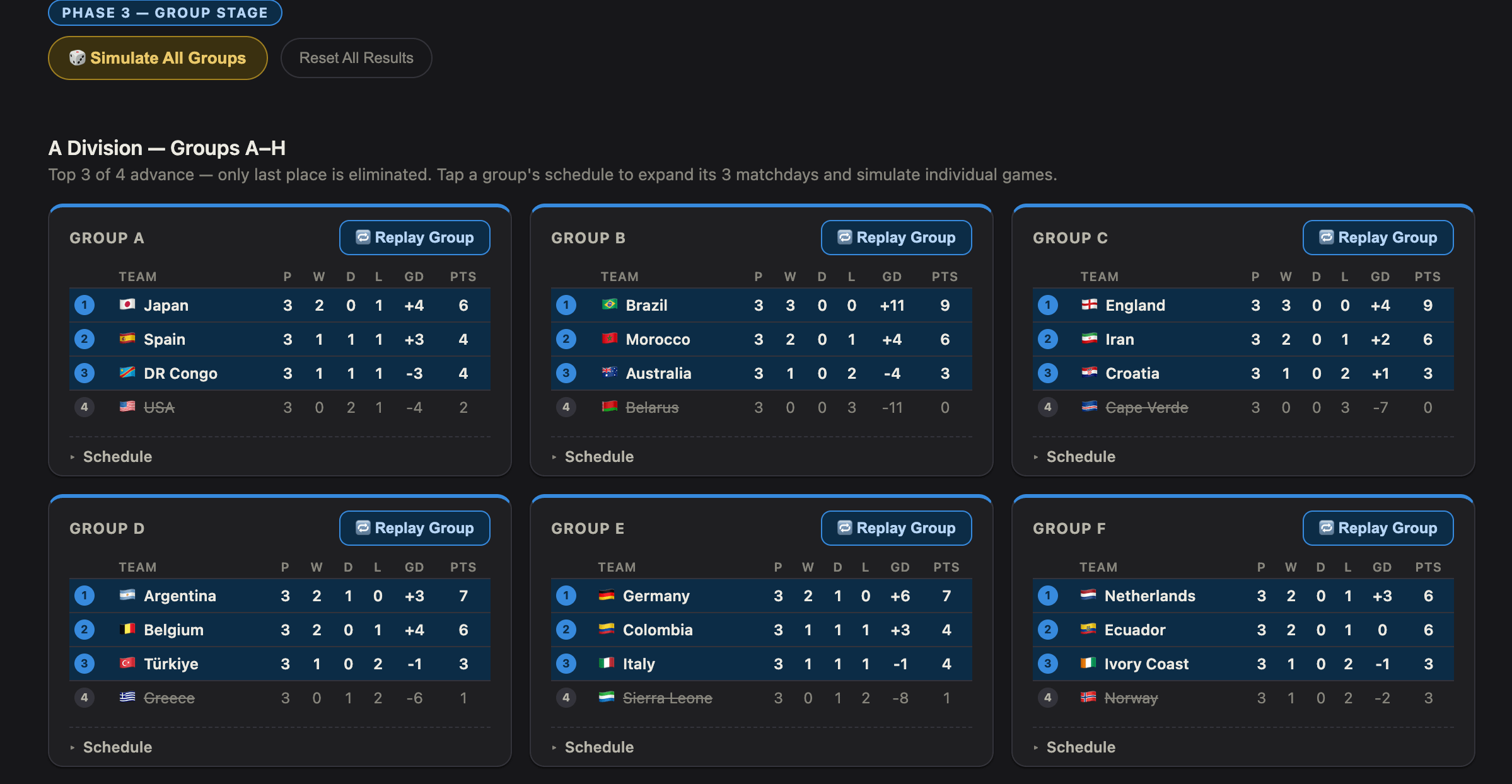
Each of those groups plays off against each other as per usual, but the big difference is the top three teams of every single “A” group move on to the round of 32. This results in the top 32 teams in the world playing against each other for 24 knockout spots. The fourth-place teams are eliminated at the end of the group stage.
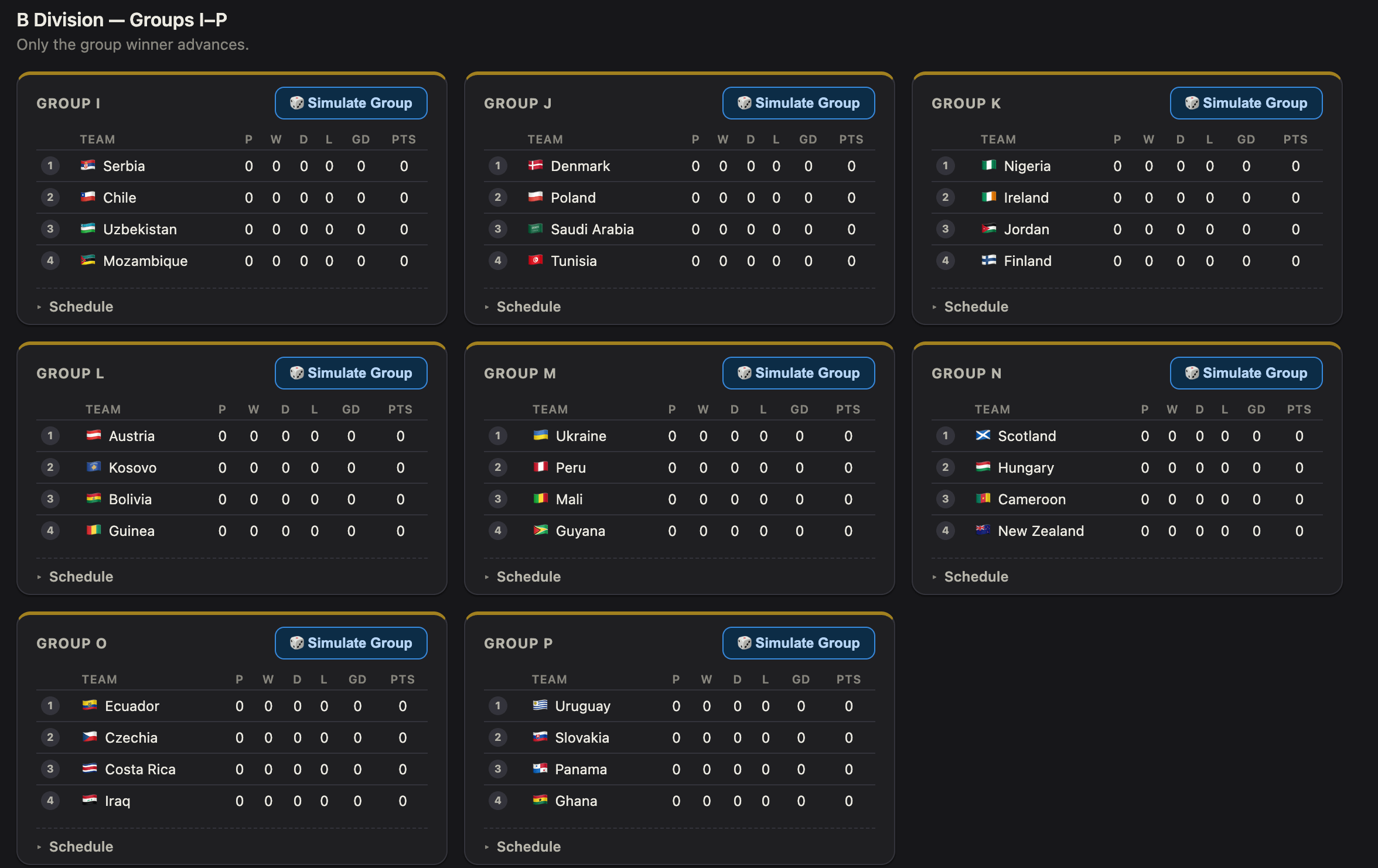
In the B division, it’s also eight groups of four, reaching 32 teams, but these are the bottom 32 ranked teams in the World Cup. This is where you see Curaçaos, New Zealand, Uzbekistans, etc. For each group, only the group winner moves on to the knockout stage.
Top finishers in A division groups will play against the top finishers in B division groups. The rest of the round of 32 comprises 2nd- and 3rd-place finishers from groups in the A division.
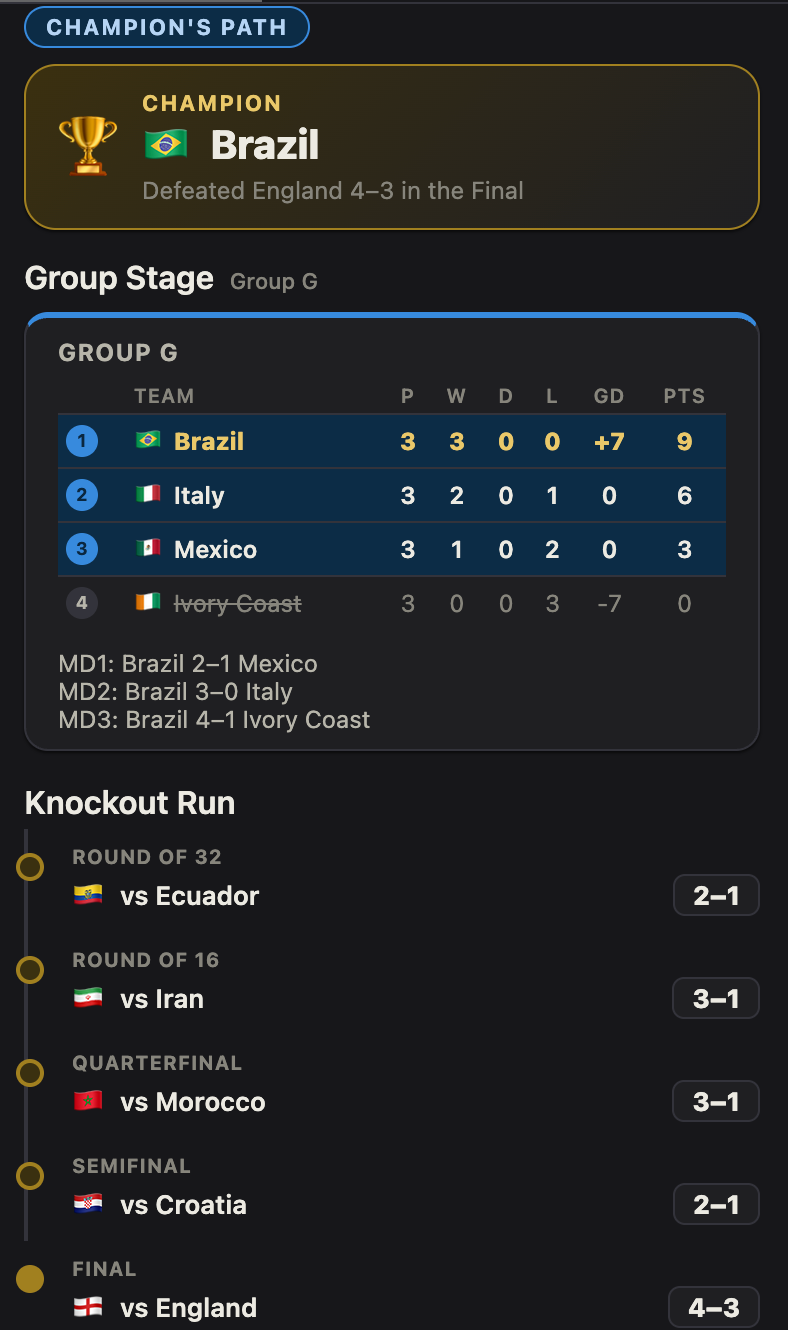
The key here is that any team can in theory go on a Cinderella run and win the whole thing.
This format solves each major concern discussed earlier. Every group stage match becomes meaningful. Seeding matters in the A division, getting 3 points matters in the B division. While you might find a matchday 3 fixture that doesn’t have competitive relevance, this is a problem that already exists for minnows. Even so, in that case, where it’s Tonga against Armenia, both teams would now have a realistic chance of getting their first World Cup win or their first World Cup goals. These are meaningful consolation prizes that aren’t available to the minnows in a straight 4-pot format.
By its very nature, and perhaps most importantly, the delta in quality between teams will be much lower. The matches will all be competitive. Curaçao doesn’t have to play Germany anymore. They get to play against teams at their own skill level.
More teams means more slots, but FIFA will need to allocate them properly. Giving more slots to Europe means justice from a competition perspective. The two-tier format also means that qualification becomes a lot more interesting. Suddenly nations need to play for seeding. As it stands in South America, you only have to be in the top six or seven to qualify, whereas in this new qualification format, perhaps only the best four or five teams will make it to the top tranche, which will incentivize them to win more. This prevents qualified teams from resting on their laurels, and allows for a longer, more significant qualifying schedule.
Notably, this would be a win for everyone in the chain, which means FIFA might actually go for it. It’s a win for FIFA. Gianni Infantino gets more games. More games means more money. Hooray for FIFA. It’s a win for all the confederations because it adds more slots in qualifying. It is a win for every country because now qualifying is more forgiving for tougher confederations, and minnows will have a chance to actually win games and pursue more than simply being at the tournament.
Most importantly, it is good for fans because we get to watch games that matter.
There is no “perfect” format, this one will have some fixtures that don’t matter. There will still be blowouts. FIFA will always have its warts. But there are side benefits to this as well. You can ensure the A division games are played in the bigger, more expensive stadiums. The smaller matches might be made more affordable (look, we can dream).
FIFA is going to FIFA, they can’t turn down money - so they will almost certainly go with a 64-team format that has a straight 16 groups of 4. But maybe, just maybe, they can adopt this format and make the competition competitive again.
To demonstrate the format for those who prefer to see it, I spent some time a few weeks back building a simulator. It includes everything from qualification all the way to the end.
You can check it out here: https://www.worldcup64.com/
(The double comment was not intended, bad wifi, sorry - but you get the gist of what I am saying)
I admire the creativity but I think this has the potentially fatal flaw of devaluing games much further than they otherwise would be. Right now, with every team largely divided in the same manner, you dont have a class of matches that instantly marked inferior. Some matches are obviously better than others re: intrigue, but there's no clear line and big sides can play smaller ones.
Here, youre clearly setting up a group of teams who are second tier, and theyre being scheduled at roughly the same time as the top tier. This is a bit like a promotion/relegation system in a typical club league (absent the relegation of course). We see how that dynamic plays out, uniformly, within systems that have 1st tiers and 2nd tiers clearly delineated: the 2nd tier draws far less capital, far less viewership, fewer fans, and just less interest overall. Its never equal, and actually never really even close to equal.
Bring that dynamic to the world cup, and you get a much less valuable world cup. The "B division" is going to be disproportionately neglected by fans and viewers, and that will drag the tournament down as a whole from a financial perspective. Broadcasters and sponsors are going to want a discount on matches where it is guaranteed that lesser teams will be the exclusive competitors playing in smaller, less appealing venues in front of fewer people.
To be clear, the idea is competitively appealing. It does allow for fewer lopsided matchups. It makes it a lot easier for fans who want to see top teams only to focus their energy on those matches only (which, as I noted above, is bad for the value of the world cup as a whole but nice for those fans). And smaller teams could walk away from tournaments with better results than they otherwise would, while still getting to say they made it to the big stage. You are hitting on all of these points. To be candid, I expected to hate this idea a lot more than I did as a fan of a smaller country (Jamaica), but theres some merit here, truly.
But the price is far too large. Its still more games, so it should be more money than a 32 team tournament had been. But its likely far less money (I am thinking billions shaved off of what could be a $16B+ 64 team tournament) than FIFA could otherwise get with a 64 team tournament in a traditional format. FIFA is going to have to try and sell a B-division, and we know how that goes - it will be worth much less. Compare revenue or broadcast rights between first and second divisions globally, and you see financial cliffs - 70-90% drops are the norm between first and second tiers in major European pyramids. Lets assume because this is the world cup, drops are drastically smaller than this - 25-30%. Thats at least $4B in lost value. And thats probably a generous underestimate.
You may contend "its the world cup, decreased value wont apply here" but I just dont think thats a credible argument. The rule on lower value for second divisions holds everywhere, globally, with no real exceptions - there's little reason to believe that a "World Cup B" fully exclusive of the top 32 sides and competing in venues people would less prefer to visit will be that exception. Curaçao's 3 games are much more valuable to broadcasters when there's a Germany or Ecuador on the schedule, and stadiums fill up more readily as well in that scenario. If its just going to be Indonesia, Kosovo, and Guinea, then there will be a very significant discount. You cant get around that. You cant offer less and expect the same price.
The value of the world cup as a unified package is just going to be far greater than it will be as a split deal. And that I think is what will ensure this never happens. Nobody is going to want to leave the kind of money this reduced value would represent (as I noted, likely several billions of dollars) on the table.