
Okamoto to Murakami: How Japan Conquered Baseball's Biggest Stage
Sixty years ago, a twenty-year-old hummed a pop song on his way to a Shea Stadium mound and changed baseball forever. This week, Kazuma Okamoto brings the next chapter to Toronto.
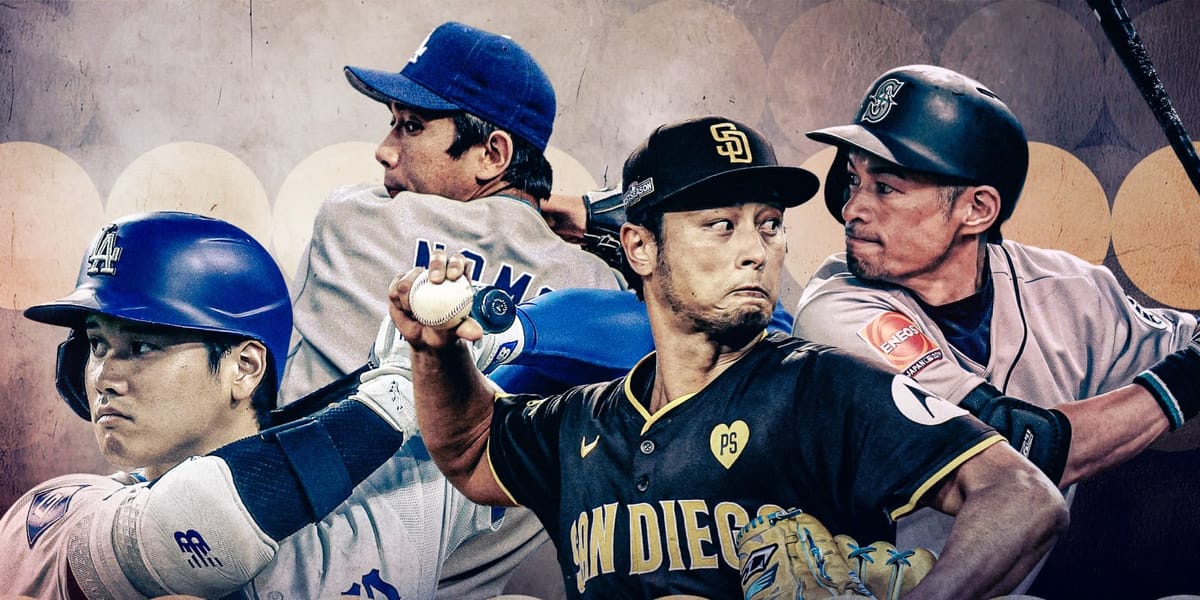
There's a moment early in Hideo Nomo's 1995 debut season that captures something essential about what Japanese players have had to do every time they've transitioned to MLB. He stood on a Dodger Stadium mound with that wind-up — the one that had opposing hitters looking like they'd never seen a baseball before — and faced a National League that had no idea what was coming. The Tornado, they called it. And true to its name, it changed everything in its path.
The story of Japanese players in Major League Baseball is, at its core, a story about what happens when you show up somewhere new and perform so well that the world has no choice but to rethink everything it assumed. It's a story that keeps getting told and keeps getting more astonishing with every chapter. This year, a new one begins at Rogers Centre. His name is Kazuma Okamoto, and he is the latest chapter in a sixty-year arc that started, improbably, at Shea Stadium in 1964.
The man who hummed “Sukiyaki” on the mound
On September 1, 1964, a twenty-year-old named Masanori Murakami walked out of the bullpen at Shea Stadium — reportedly humming a Japanese pop song to calm his nerves — and became the first Japanese player to appear in a Major League Baseball game. He was there because the Nankai Hawks had sent him as a baseball exchange student. The Giants noticed his arm quickly. In parts of two seasons, he posted a 5-1 record and a 3.43 ERA, striking out over a batter per inning. A fan club formed. A local restaurant put a Murakami cocktail on the menu. He was, plainly, good enough to belong.
And then he was gone. A dispute erupted between the Giants and the Hawks over his contract rights — the Giants believed they had purchased him outright; the Hawks insisted he had only been loaned. The argument escalated through the off-season until the NPB commissioner brokered a compromise: Murakami would return for one more year, then go home for good. He pitched in 45 games for San Francisco in 1965, saving eight, and then boarded a plane back to Japan. He pitched there for another seventeen years. The door that had cracked open swung quietly shut, and it would stay that way for three decades.
The Tornado that opened the floodgates
What Nomo did in 1995 was different in kind. Mashi had been sent. Nomo chose. He exploited a loophole in NPB's retirement rules to sign with the Dodgers — a move viewed in Japan, initially, as a betrayal. The doubt in America was equally pointed. Could a Japanese pitcher really compete at the highest level, against the hardest throwers and strongest hitters, in front of the biggest crowds?
The short answer: 2.54 ERA. 236 strikeouts. NL Rookie of the Year. The Tornado turned out to be entirely unhittable for stretches of that first season, and Nomo eventually compiled 123 MLB wins across twelve seasons. But his statistics undersell his real contribution. What Nomo did was break the psychological barrier. After him, Japanese fans woke up at four in the morning to watch MLB games. After him, teams sent scouts to Japan in earnest. The posting system — the formal mechanism allowing NPB players to negotiate with MLB clubs — was built in his wake. He didn't just prove Japanese players could make it. He rewired the entire relationship between the two leagues.
Ichiro and the art of proving everyone wrong
If Nomo opened the door, Ichiro Suzuki walked through it so magnificently that he rebuilt the house on the other side. When the Seattle Mariners paid $13.25 million just for the right to negotiate with Ichiro in 2001, there was genuine skepticism that a Japanese position player — not a pitcher, where the transition was at least somewhat understood — could hit major league pitching. This was the home run era. The league was enormous, juiced and slugging. Ichiro was five-foot-eleven and 170 pounds soaking wet. His weapon was a pendulum swing that produced line drives and bunt singles.
What followed was one of the great debut seasons in sports history: a .350 average, 242 hits breaking a rookie record from 1927, 56 stolen bases, AL Rookie of the Year and AL MVP in the same season. He collected 200 or more hits in each of his first ten MLB seasons, set the all-time single-season record with 262 in 2004, and finished with 3,089 MLB hits. In 2025, he became the first Japanese-born player inducted into the National Baseball Hall of Fame, and the ceremony in Cooperstown drew Japanese fans who'd made the pilgrimage just to watch.
The wave that followed is impossible to argue with: Hideki Matsui won World Series MVP with the Yankees in 2009. Yu Darvish, Masahiro Tanaka, Kenta Maeda — each one another proof of concept, another argument for the scouts, another reason for the next player to believe the crossing was worth it.
Shohei Ohtani and the limits of description
At some point, writing about Shohei Ohtani requires acknowledging that the English language may be genuinely insufficient for the task. He arrived with the Angels in 2018 as a two-way player — starting pitcher and elite hitter — and the consensus was that one of those things would have to give. Nobody had sustained this at this level since Babe Ruth, and even Ruth eventually chose. Ohtani did not choose.
He won the AL MVP unanimously in 2021: 46 home runs, 10 pitching wins, the first player in history to accomplish that feat. He struck out Mike Trout to close out the 2023 World Baseball Classic, winning the title for Japan on the sport's biggest international stage. Then he signed with the Dodgers for ten years and $700 million — the largest contract in professional sports history at the time — and in his first LA season became the first player ever to hit 50 home runs and steal 50 bases. He won consecutive NL MVPs in 2024 and 2025, returning to the mound in his second Dodgers season while hitting 55 home runs, leading Los Angeles to the World Series title. The numbers stop making sense at a certain point. They feel less like statistics and more like dispatches from a different category of athlete.
Toronto's moment: Kazuma Okamoto arrives
Toronto has been circling the Japanese market for years — Shohei Ohtani's name came up in Blue Jays conversations more than once; Roki Sasaki was reportedly of interest. Neither happened. What did happen, in January 2026, was a four-year, $60 million deal with a 29-year-old infielder from the Yomiuri Giants who goes by a nickname that tells you something important before you've seen him swing: the Young General.
Kazuma Okamoto spent eleven seasons as one of the most feared hitters in NPB, slugging 248 home runs for the Giants — the Yankees of Japanese baseball. He led the Central League in home runs three times and earned six All-Star selections. In 2023, fully healthy, he hit 41 home runs with a .958 OPS, then capped the year by hitting a solo home run in the World Baseball Classic final to help Japan beat Team USA. He is, by any honest measure, the real thing.
He arrived at his Blue Jays introductory press conference and opened in English: 'I am very happy to join the Blue Jays. I will work hard every day and do my best for the team.' Through an interpreter, he explained his reasoning: the roster was strong, the franchise well-run. And when he asked his daughter to choose her favourite logo from among all thirty MLB teams, she pointed at the Blue Jay. There's something quietly perfect about that — a city landing a player because a child pointed at a bird and said yes.
Spring training offered early evidence the investment was well placed. He slashed .316/.435/.632 in Grapefruit League play, and a home run off Clay Holmes in February had Statcast analysts noting that only a handful of right-handed hitters in the modern era have made that kind of contact on that pitch location. The translation question always lingers — NPB pitching is not AL pitching, and every Japanese star who's thrived here still went through an adjustment period. But what Okamoto's numbers reveal is a patient, disciplined hitter: an 11.3% walk rate in his injury-shortened 2025 season, a strikeout rate that matched his walk rate exactly. He adjusts. That tends to matter.
What Toronto gets, beyond the bat, is something harder to quantify: a connection to a market and a tradition the Blue Jays have wanted for years. A dozen Japanese reporters filled the press conference room at his January introduction, outnumbering the local contingent. Spring training was similarly busy with cameras from across the Pacific. The Blue Jays have understood for some time that signing a Japanese star means more than signing a player. It means opening a conversation with a baseball culture that is enormous, passionate, and paying close attention. Rogers Centre, which has seen plenty of history already, is about to become part of a story that started more than sixty years ago for the first time and shows no signs of slowing down.
What sixty years of crossing the Pacific has taught us
What the full arc looks like, compressed: a twenty-year-old humming a pop song as he walks to a mound at Shea Stadium. A tornado windup dazzling Dodger Stadium in 1995. A man named Ichiro — just the one name, a legend — getting 200 hits a year for a decade straight. A two-way player who made Babe Ruth look like a reasonable comparison. And now: a man called the Young General, standing in a Blue Jays hat, telling a Toronto crowd he's here to work hard and do his best.
Those words carry more weight than they might seem to. Every player who made this crossing said something like them. Very few of them were just being polite.
The season starts this week. Pay attention.
Comments ()