
Italy Deserved the World Cup. FIFA's Format Robbed a Nation.
Italy went 7-1-2 in the toughest confederation in the world and still missed the World Cup. The problem isn't Italy. It's FIFA's broken format.
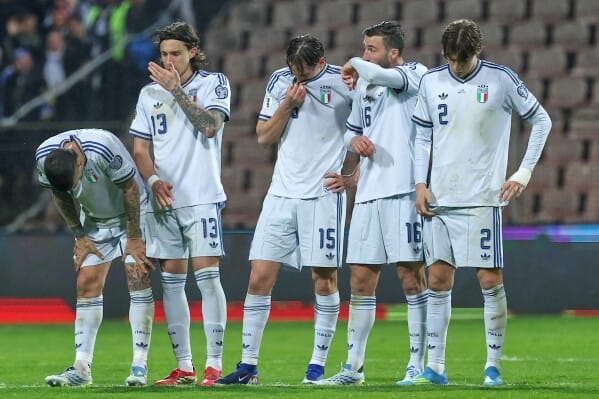
Italy Didn't Miss the World Cup. The World Cup Missed Italy.
No, there's no need for a referendum on Italian football. The Italians got jobbed — and it's probably not why you think. This isn't about your typical sports gripes: referees, coaching decisions, or bad luck. The Italians and their fans should have a gripe with FIFA and UEFA for having absurd mechanisms for qualifying for the World Cup in the first place.
The Numbers
While they certainly weren't perfect, here's what Italy did in qualifying: 7 wins, 1 draw (the Bosnia game ended in a tie), 2 losses. A 73.3% points percentage. That's a better qualifying record than European teams Portugal, Scotland, and certainly Bosnia, and Sweden — all of whom are going to the tournament. Outside of Europe, Brazil qualified with 52%, Qatar with 59%. Island nation Curaçao qualified with 80%, but they got there by beating Suriname and Guatemala.
In the first round, Italy beat everyone except Norway and still went home.
The FIFA Rankings Problem**(see bottom)
FIFA has a rankings system that determines seedings for qualifying and tournaments (brought to you by CocaCola). It's better than nothing because it typically prevents Argentina from playing Spain in the group stage. But there are fundamental flaws. The system doesn't take into account certain key metrics like margin of victory, the fact that penalty shootout wins are really ties, or home field advantage (a major factor in international soccer.
The FIFA rankings don't account enough for the strength of the opponent. That's a big problem.
There is a much better system they could use called ELO — the same model used in chess. If Magnus Carlsen beats a hobbyist, his rating barely moves. If the hobbyist somehow beats Carlsen, their rating skyrockets. The system knows the difference. ELO isn't tracked by FIFA, but it is tracked independently at eloratings.net. FIFA, of course, doesn't use it.
FIFA recently changed how they do their rankings, but it's still a ways off from ELO - and the differences in
The UEFA Gauntlet
Europe decided to divide their qualifying into 12 groups, with one team qualifying per group. Italy got the short straw and drew Norway - who ELO sees as a top-12 team in the world. They could have drawn Hungary, Iceland, or Bosnia. Instead they got Erling Haaland's Norway. Subsequently, they went 6-2 in that group, finished second, and then had 2 do or die must win games to make it.
If we accept that Norway is indeed that good, it means that from the outset, Italy only had about a 40% chance of qualifying. If we give them a 50% chance of getting in via the playoffs - that's still only 70% total. That's not a reflection of how good Italy is - it's a reflection of a format that put a top-20 team in an unfair spot from the jump because some ping-pong balls ended up going a certain way.
Shootouts Are Basically a Coin Flip
Here's where the playoff format is unjust for teams like Italy. In group play, the 3-points-for-a-win system incentivizes attacking football (ie, trying to win). You can't sit on draws when your opponent might beat someone else later. That changes completely in a one-off knockout game - because now there's another option. The penalty shootout.
What this means is that if you're a heavy underdog, your best strategy isn't to win. It's to not lose. Get to penalties and it's basically a coin flip. The pressure actually flips to be worse for the favourite, the Italians knew what was at stake. This uniquely works for underdogs in soccer because it's really hard to score goals in the sport. A team sitting back and never trying to score can grind to 90 minutes and suddenly they're 50/50 to go through.
The end result is you end up in this weird situation where one team isn't actually trying to win - they're just trying not to lose. And the odds are often in that team's favour.
That's what happened to Italy. In this game in particular, they were winning, but they also lost a player to a red card (which is its own massive variable) and ultimately went out on the coin flip tiebreaker; penalties.
Who Actually Gets In
The cruelest part perhaps isn't that Italy missed out. It's who made it in instead. Qatar is in the field - after hosting in 2022, they qualified through a weak AFC (Asia) group with a 59% points percentage across 18 games. Curaçao, a Caribbean nation of just 150,000 people qualified by essentially fielding the Dutch C team. Players who never had a shot at playing for the Netherlands, get citizenship, and then get to spend their weekends beating weak Central American opposition like Bermuda - a team full of bankers and trades guys. Meanwhile Italy went 7-1-2 in UEFA and gets to watch the world cup from home.
There is genuinely 0 chance some of these small teams win a game at the World Cup. Should a team be there if they have no chance of winning? That's a real question FIFA should be asking. They almost certainly won’t, however.
These confederations all pay their dues to FIFA, and like so many things in life, it comes down to money. Individual soccer federations make lots of money just for making the world cup. It is not unreasonable to think that there are incentives other than the “pure joy of sport” at play here.
How to fix it
There are plenty of potential fixes and improvements available:
1. Open up inter-confederation qualifying so you're not punished for being geographically next to the best teams on earth.
2. Emulate the champions league and allocate spots in the world cup based on performance. In other words, if all the African teams perform well, and none of the South American teams perform well, the next World Cup should reflect that. UEFA already does this in their champions league with countries like England getting to send more teams than Denmark.
3. Get rid of one-off knockout games in qualifying entirely - if the whole point is figuring out who deserves to be there, you want formats that reduce variance, not blow it wide open. Group stage points tables do that. Single elimination shootouts don't.
4. Come up with an alternative to penalty shootouts. Incentivize winning instead of incentivizing "not losing".
5. Ditch the FIFA rankings and start adopting ELO for seeding. FIFA can make it the "CocaCola ELO rankings".
Moving Forward
Italy didn't choke. They got put in a bad position by a system that was never really designed for merit. Detractors will say, "just win", but that doesn't mean it's fair. Now, the world misses out on experiencing Italy on the world stage.
There's much more here, deep dives into confederation allocations, the Nations League path, teams playing in confederations outside their physical location, and so much more, but that's the essence of FIFA - controversy.
As a final extra gut punch: because Italy didn't qualify, and because FIFA doesn’t use the ELO rankings, they now will be seeded as a second tier team for the next qualifying cycle. That means that Italy will likely have to do it all over again, maybe against Spain or France. It also means, that those other teams, will now have to get through Italy to get back to the world stage. Meanwhile, New Zealand will have their qualification depending on whether or not they can take down New Caledonia (which yes, is a place that exists).
Correction: ** A previous version of this article (Prior to April 5th) had misinformation about the FIFA world rankings. They aren't as bad as they were prior to 2018, but they still aren't as good as ELO **

Comments ()